
Ever wondered how much water volume is in your closed loop?
Posted by David Cannon on 16th Aug 2018
Often we get calls from our customers who are looking for corrosion inhibitor chemicals or glycol for their closed loop systems. The first question we ask is 'How much water does your system hold?' and the answer is always 'I don't really know'. To figure this out the plumber or mechanical contractor might try and estimate the volume by counting the length and diameter of the pipe installed but this does not take into account all of the fittings, valves, water heaters, boiler capacity etc. The estimate will most likely miss the mark and could cost the customer a lot of money in chemicals. Worst case is the system may be under treated requiring diluted chemical to be drained to make room for more concentrate to be added costing both time and money.
A much better way to estimate the system volume is to add a little salt, test the chloride levels with a test kit and mathematically calculate system volume within a few gallons of it's capacity. The following procedure lays this out step by step.
Closed System Volume Measurement Procedure Using Salt
- Fill the closed system piping with fresh water. Circulate the water and flush the lines until the water is clear.
- Measure the chloride concentration in the closed system and estimate the volume of the closed system
- Estimate volume in a closed system.
- A. Rough Rule-Of-Thumb Estimate - Rated Tonnage of System X 10 gallons = Volume
- B. Use a pipe volume chart to estimated system volume
- Add one pound of Table Salt (Sodium Chloride) per 1000 gallons of estimated volume via the chemical bypass feeder. Make sure the salt mixes thoroughly with the water.
- Allow one hour of circulation to disperse chloride ions uniformly throughout the system.
- Re-measure the chloride concentration in the closed system.
- Multiply the estimated gallons of water by 76 ppm. Divide this product by the difference (increase) in chloride concentration of the test after adding the salt.
The answer will be the actual volume of water in the system.
Example
Estimated Volume 1000 gallons
Initial Chloride Test 100 ppm
Final Chloride Test 180 ppm
Calculation
1000 gals. X 76 ÷ (180 - 100) ppm = 950 actual gallons in system
This same procedure can be used to estimate the total water volume of a Cooling tower or Boiler Water System
Use our Chloride Test Kit with this procedure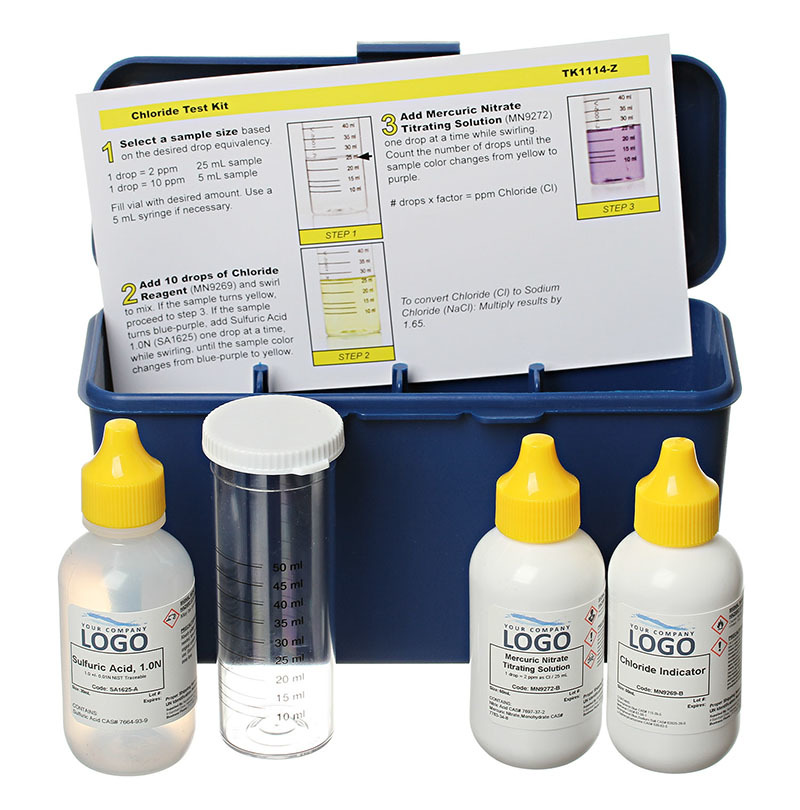
Chloride Test Kit CNTK1114-Z
We sell a full range of Water Treatment Chemicals, test kits and equipment to include:
- Corrosion Inhibitors
- Scale Inhibitors
- Microbiocides
- Inhibited Propylene Glycol
- Closed Loop Cleaners
- Dispersants Anti-foamers
- Chemical Test Kits
- Chemical Bypass Feeders
- Cooling Tower Chemicals
- Steam Boiler Treatment
- Drain Line Treatment
- Porta Potty Chemical
Please contact us to discuss your water treatment needs today.