
How Liquid Solid Separators Improve Industrial Water Quality and Reduce Operating Costs?
Posted by David Cannon on 28th Aug 2026
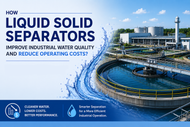
Properly selected separation equipment separates solids from liquids and can help facilities improve water quality, protect downstream equipment, and make better use of available water resources. If these solids are not effectively removed, they can contribute to fouling, clogging, maintenance requirements, and inconsistent treatment performance.
An effective liquid-solid separation process helps address these challenges by removing unwanted particulate matter from industrial water before it reaches subsequent treatment stages. A properly selected equipment separates solids from liquids and helps facilities improve water quality, protect downstream equipment, and make better use of available water resources.
How a Liquid-solid Separator Works?
Solid-liquid separation primarily targets suspended and settleable particulate matter; it does not, by itself, remove all dissolved contaminants from industrial wastewater. Industrial liquid-solid separator designs vary according to the application; however, here are the basic separation process steps.
- Feed Collection: Industrial wastewater or process water containing suspended solids is directed into the separation system. The characteristics of the incoming stream, including flow rate, solids concentration, particle size, and liquid composition, influence the appropriate separation method.
- Flow Conditioning: The incoming liquid may be conditioned to create more consistent flow through the system. Equalization or other upstream processes can help manage variations in flow and solids loading. Consistent operating conditions can improve separation performance and help the equipment operate more reliably.
- Particle Separation: The separation system applies a physical mechanism to remove solids from the liquid. Depending on the equipment, this may involve screening, settling, filtration, centrifugal force, or a combination of methods. The objective is to create conditions in which particulate matter can be removed from the liquid stream efficiently.
- Solids Collection: Once separated, solids are collected within a designated chamber, hopper, screen, filter, or discharge mechanism. The method used depends on the type and concentration of solids being handled.
- Treated Liquid Discharge: After the separation stage, the clarified liquid moves to the next treatment process or, where water quality requirements allow, to a designated reuse application. Removing a substantial portion of solids at an early stage can reduce the contaminant load placed on downstream treatment equipment.
- Solids Removal: Accumulated solids must be removed from the system at appropriate intervals. Automated or continuous discharge mechanisms may be used in some industrial applications to reduce manual handling and maintain consistent operation.
Common Liquid-solid Separation Techniques for Industrial Applications
Industrial facilities use different liquid-solid separation techniques based on the type, size, and concentration of solids in the wastewater stream. Some facilities combine multiple separation techniques to achieve the desired treatment performance. Common solid-liquid separation techniques include:
- Screening and Straining: Screens and strainers remove larger particles, debris, fibers, and other materials from liquid streams. They are often used as an initial separation step to protect pumps and downstream treatment equipment from excessive solids loading.
- Gravity Separation: Gravity-based systems allow heavier particles to settle when sufficient retention time is provided. This approach can be effective when solids have suitable density and settling characteristics.
- Filtration: Filtration removes suspended particles as liquid passes through a selected filter medium. Filter selection depends on particle size, solids concentration, flow requirements, and the desired treated-water quality.
- Centrifugal Separation: Centrifugal force can accelerate the separation of solids from liquids by increasing the effective force acting on particles. Depending on equipment design and application conditions, liquid-solid centrifugation can be used for clarification, thickening, or dewatering.
Key Components of Liquid-solid Separation Equipment
The design of liquid-solid separation equipment depends on the separation technology, wastewater characteristics, flow rate, solids concentration, and treatment requirements. Key components work together to control flow, separate solids, and maintain reliable system performance.
- Feed Inlet: The feed inlet introduces wastewater or process water into the system. Proper design helps distribute flow evenly, minimize turbulence, and maintain consistent separation conditions. Valves and flow controls may regulate the incoming stream.
- Separation Chamber: This is the primary area where solids are removed from the liquid. Its design varies by technology. Gravity systems provide settling space, filtration systems contain filter media, and centrifugal systems use rotational force to separate particles.
- Screen or Filtration Media: Screens and filtration media capture suspended particles as liquid passes through the system. The opening size or media selection depends on particle characteristics and the required level of solids removal.
- Solids Collection Area: Separated solids are collected in hoppers, baskets, settling zones, chambers, or sludge compartments. Proper sizing helps accommodate solids volume and prevent excessive accumulation.
- Discharge Mechanism: This component removes collected solids from the system. Depending on the equipment, discharge may be manual, periodic, or continuous. Automated discharge can support consistent operation in systems with higher solids loads.
- Pumps and Flow Controls: Pumps, valves, and control devices regulate liquid movement through the system. Maintaining suitable flow conditions helps support separation efficiency and prevents excessive solids from reaching downstream treatment stages.
- Monitoring and Controls: Sensors may monitor flow, pressure, turbidity, level, or differential pressure. These controls help operators identify changes in solids loading, filter condition, and overall system performance.
How Liquid-Solid Separators Help Lower Operating Costs
Here are several ways liquid-solid separators can help lower operating costs:
- Reduces Downstream Solids Loading: Removing suspended solids before subsequent treatment stages reduce the amount of particulate matter that downstream equipment must handle. This can help improve treatment performance and reduce operational strain.
- Protects Treatment Equipment: Excessive solids can contribute to fouling, clogging, abrasion, and wear in pumps, filters, membranes, heat exchangers, and other equipment. Effective separation can help reduce these issues and potentially lower repair and replacement requirements.
- Reduces Cleaning and Maintenance: Lower solids accumulation can reduce the frequency of cleaning, filter servicing, and other routine maintenance activities. The actual savings depend on the equipment, solids characteristics, and operating conditions.
- Improves Downstream Treatment Efficiency: Consistent solids removal can help downstream treatment systems operate with a more manageable solids load. This may support more stable operation and reduce unnecessary operational demands.
- Supports Efficient Water Reuse: Removing suspended solids can serve as an important preliminary step in a broader water reuse treatment process. By preparing the water for subsequent treatment, separation can help facilities make better use of available water resources.
- Reduces Solids Handling Requirements: Separating solids from the liquid stream allows facilities to manage the concentrated solids separately. In applications involving thickening or dewatering, reducing the volume of water associated with solids can potentially lower handling, transportation, and disposal requirements.
- Helps Extend Equipment Service Intervals: Reducing the amount of solids reaching downstream components can help minimize wear and fouling. This may allow certain equipment to operate for longer periods between maintenance activities, depending on the application.
Factors to Consider When Selecting Liquid-solid Separation Equipment
Selecting liquid-solid separation equipment requires more than comparing equipment capacity. Facilities should evaluate the characteristics of their water stream and the requirements of the complete treatment process.
- Type of Solids: Determine whether the wastewater contains sand, sediment, fibers, organic particles, process residues, sludge, or other materials. Different solids may require different separation approaches.
- Particle Size and Density: Evaluate particle size and density because they directly affect separation performance. Fine or low-density particles may require more advanced separation methods, while larger or denser solids are often easier to remove.
- Solids Concentration: Assess the solids concentration entering the system because it influences equipment sizing, loading capacity, solids discharge requirements, and maintenance intervals.
- Flow Rate: Select the equipment according to expected minimum, average, and peak flow conditions. Oversizing or under sizing a system can affect operating efficiency and performance.
- Required Water Quality: Define the intended use of the treated water to determine the required level of solids removal. Water that will undergo additional treatment may require a different level of solids removal than that for a specific reuse application.
- Available Space: Evaluate equipment footprint, access requirements, piping, and installation considerations before selecting a system.
- Maintenance Requirements: Consider how screens, filters, collection areas, and other components will be cleaned and serviced. Systems that simplify solids handling may be advantageous for certain facilities.
- Solids Disposal: Separated solids still require appropriate handling and disposal. Consider the expected solids volume and disposal method during system selection.
- Integration With Existing Treatment: Ensure the separation system integrates effectively with upstream and downstream equipment. Proper compatibility can help prevent bottlenecks, minimize unnecessary loading, and support consistent performance across the treatment process.
- Operating Conditions: Evaluate temperature, pH, viscosity, chemical composition, and other liquid characteristics because they can affect equipment selection, separation performance, and overall system reliability.
Find the Right Liquid-solid Separation Solution for Your Facility
Every industrial water stream has different flow conditions and solids characteristics. Cannon Water Technology offers a range of centrifugal separators and filtration solutions for applications ranging from process water treatment to equipment protection and wastewater systems. Contact our team with your application requirements to explore a suitable solids separation system.