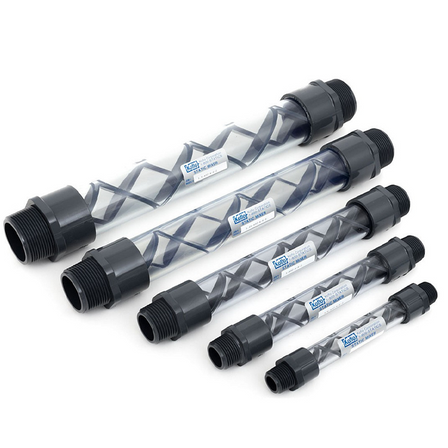
Cannon Water Technology Pro-Mix Inline Static Mixer
Improve chemical dispersion directly inside your water line with the Cannon Water Technology Pro-Mix inline static mixer. Designed for continuous liquid blending, the Pro-Mix uses a series of fixed internal mixing elements to repeatedly divide, redirect and recombine the flowing water and injected chemical.
This motionless mixing process promotes more uniform chemical distribution without an electric motor, powered agitator or moving mechanical components.
The Pro-Mix is an economical solution for water-treatment systems, chemical-feed skids and industrial processes where a metering pump injects liquid chemical into a continuously flowing pipeline. Its compact true-union design makes the mixer easy to install and remove for inspection or cleaning.
Product highlights
-
Inline mixing of water and liquid treatment chemicals
-
No motor, electricity or moving mechanical parts
-
Engineered internal elements promote rapid chemical dispersion
-
True-union connections simplify installation and removal
-
Clear and solid PVC configurations available
-
Horizontal or vertical installation
-
Compact design for chemical-feed skids and tight equipment rooms
-
Corrosion-resistant construction for compatible chemicals
-
Available in multiple common water-line sizes
-
Suitable for residential, commercial and industrial water-treatment systems
Why install a static mixer after a chemical injection point?
Injecting a chemical into a pipe does not guarantee that it will immediately mix throughout the entire water stream. Without adequate mixing, a concentrated ribbon of chemical can travel along one side of the pipe. This can cause uneven treatment, localized chemical concentration and inaccurate readings from downstream sensors.
The Pro-Mix creates controlled turbulence as water passes through its fixed internal elements. The flowing water and injected chemical are divided, redirected and recombined to improve distribution across the pipeline.
More uniform initial mixing can help:
-
Improve chemical-feed consistency
-
Distribute treatment chemicals across the water stream
-
Reduce localized areas of high chemical concentration
-
Improve oxidation and pH-adjustment performance
-
Provide a more representative sample to downstream analyzers
-
Make better use of available reaction piping
-
Simplify packaged chemical-feed system design
-
Reduce the need for powered mechanical mixing equipment
A static mixer improves initial dispersion, but it does not create additional reaction or disinfection time. Applications requiring a specific contact time may still need downstream piping, a retention tank or a properly baffled contact tank.
Water-treatment applications
Chlorine and sodium hypochlorite injection
Install the Pro-Mix downstream of a chlorine injection point to promote rapid dispersion of sodium hypochlorite throughout the water stream.
Common applications include:
-
Well-water chlorination
-
Commercial water-system disinfection
-
Process-water treatment
-
Storage-tank recirculation
-
Wastewater disinfection
-
Iron and manganese oxidation
-
Hydrogen sulfide treatment
-
Packaged chlorine-feed systems
Improved initial mixing helps prevent concentrated chlorine from remaining along one side of the pipe. It can also help a downstream chlorine analyzer receive a more representative sample.
The mixer does not replace required chlorine contact time. Systems designed for disinfection must still provide the necessary effective contact time after injection and mixing.
Hydrogen peroxide injection
Hydrogen peroxide is frequently used to oxidize iron, manganese, hydrogen sulfide and other oxidizable contaminants. An inline static mixer helps disperse peroxide throughout the incoming water before filtration, retention or other downstream treatment.
pH adjustment and neutralization
Use the Pro-Mix after injecting compatible liquid acid or alkaline solutions for applications such as:
-
Lowering pH with diluted acid
-
Raising pH with caustic solutions
-
Industrial wastewater neutralization
-
Cooling-water pH adjustment
-
Process-water conditioning
-
Irrigation-water pH control
More uniform mixing can improve the stability and accuracy of a downstream pH reading. Allow adequate distance and reaction time between the mixer and the pH sensor.
Coagulant addition
The Pro-Mix can provide rapid initial dispersion of compatible liquid coagulants before clarification or filtration. Potential applications include alum, ferric solutions and other liquid water-treatment chemicals.
Concentrated polymers and viscous products require application-specific review. Polymer chemistry, concentration, viscosity and sensitivity to shear should be evaluated before selecting a static mixer.
Corrosion and scale control
Use the Pro-Mix to disperse compatible liquid corrosion inhibitors, phosphates, antiscalants and other conditioning chemicals before the treated water reaches downstream piping, membranes or process equipment.
Chemical-feed skids
The compact, non-electric design makes the Pro-Mix well suited for packaged chemical-feed systems serving:
-
Cooling towers
-
Boiler-water systems
-
Commercial water treatment
-
Food and beverage facilities
-
Manufacturing plants
-
Agricultural and irrigation systems
-
Groundwater treatment
-
Industrial process water
-
Wastewater treatment
-
Equipment washing and sanitation systems
How the Pro-Mix static mixer works
A static mixer is a section of pipe containing fixed mixing elements. As the primary water stream and injected liquid pass through the mixer, the elements repeatedly change the direction of flow.
This creates three important mixing actions:
-
Flow division: The water and injected chemical are divided into multiple flow paths.
-
Radial movement: Liquid is redirected from the center of the pipe toward the outside and from the pipe wall toward the center.
-
Flow recombination: The divided streams are brought back together repeatedly to promote a more uniform mixture.
The mixer receives all of its energy from the flowing liquid. It contains no powered impeller, motor, shaft, bearings or mechanical seals.
Clear PVC or solid PVC
Choose the construction that best matches the installation.
Clear PVC static mixer
Clear PVC allows operators to visually inspect the inside of the mixer. Depending on the application, this can help identify:
Clear PVC is generally best suited to indoor or otherwise protected installations. Protect clear PVC from prolonged ultraviolet exposure and environmental conditions outside the material’s limitations.
Solid PVC static mixer
Solid PVC is a good general-purpose choice for compatible water-treatment chemicals. It is normally preferred for outdoor installations where sunlight or ultraviolet exposure is a concern.
Chemical compatibility must be verified for all wetted components, including the mixer housing, internal elements, union seals and connecting materials.
True-union serviceable design
The true-union connections allow the mixer body to be removed from the pipeline without cutting the surrounding pipe. This makes inspection, cleaning and replacement considerably easier than with a permanently cemented mixer body.
The union ends can remain connected to the system while the center mixer section is removed.
Always isolate the system, relieve pressure and drain hazardous chemical before loosening a union connection.
Where should the static mixer be installed?
For many chemical-feed systems, the recommended equipment order is:
Water source or flow meter → chemical injection point → Pro-Mix static mixer → reaction or contact piping → analyzer sample point → downstream treatment equipment
Position the chemical injection point immediately upstream of the static mixer whenever practical. This allows the concentrated chemical to enter the mixing elements before it can travel a significant distance along the pipe wall.
Install downstream pH, ORP or disinfectant sensors only after adequate mixing and chemical reaction time. A static mixer may improve dispersion quickly, but some chemical reactions require additional time before an analyzer reading becomes stable.
The Pro-Mix can be installed horizontally or vertically. Support the adjoining piping so the mixer and union connections are not required to carry excessive pipe weight or mechanical stress.
How to select the correct static mixer
Static mixer selection should be based on operating conditions—not pipe diameter alone.
Before ordering, identify:
-
Nominal pipe size
-
Minimum water flow
-
Normal operating flow
-
Maximum water flow
-
Normal and maximum system pressure
-
Water temperature
-
Chemical name and concentration
-
Chemical feed rate
-
Chemical viscosity and specific gravity
-
Clear or solid PVC preference
-
Horizontal or vertical installation
-
Available pressure loss
-
Required connection type
-
Downstream equipment and analyzer locations
An oversized mixer may not create sufficient flow energy at low flow. An undersized mixer may create excessive velocity and pressure loss.
Contact Cannon Water Technology for application assistance when the system has widely varying flow, viscous liquid, concentrated polymer, suspended solids, limited available pressure or a critical mixing requirement.
Typical system components
Cannon Water Technology can help assemble a complete chemical injection and mixing system using compatible components such as:
-
Chemical metering pump
-
Chemical solution tank
-
Water meter or flow sensor
-
Injection check valve
-
Pro-Mix inline static mixer
-
Calibration column
-
Back-pressure and pressure-relief valve
-
Pulsation dampener
-
Flow switch
-
Pressure gauge
-
pH, ORP or disinfectant analyzer
-
Reaction piping or contact tank
-
Sample valves and test equipment
Providing the complete system information helps us evaluate how the mixer will interact with the metering pump, injection point, water flow and downstream analyzer.
Why buy your static mixer from Cannon Water Technology?
Cannon Water Technology specializes in chemical feed, process control and water-treatment equipment. We understand that a static mixer is only one part of a properly designed treatment system.
Our team can help coordinate the mixer with your chemical pump, injection assembly, flow signal, water meter, contact volume and downstream analyzer.
For selection assistance, provide:
-
Pipe size
-
Minimum and maximum flow
-
System pressure
-
Chemical and concentration
-
Chemical feed rate
-
Application or treatment objective
-
Indoor or outdoor installation
Need help selecting a mixer? Contact Cannon Water Technology before ordering, and we will help evaluate the application.
Frequently asked questions
What is an inline static mixer?
An inline static mixer is a pipe section containing stationary mixing elements. The elements divide, redirect and recombine the flowing liquids to promote mixing without an electric motor or powered agitator.
Does the Pro-Mix require electricity?
No. The mixer uses energy from the flowing water. It does not require an electrical connection.
Does it have moving parts?
No. The internal mixing elements remain stationary. This eliminates motors, shafts, bearings and mechanical seals normally associated with powered mixers.
Can it be used for chlorine injection?
The Pro-Mix can be used to disperse chemically compatible sodium hypochlorite solutions in water. The chemical concentration, temperature, mixer materials and seals must be verified for the application.
Will it replace a chlorine contact tank?
No. A static mixer improves chemical dispersion, while a contact tank or downstream piping provides reaction and disinfection time. Systems with a required chlorine CT value must still provide sufficient effective contact time.
Can it be used for pH control?
The mixer can help disperse compatible liquid acid or alkaline solutions before a downstream pH measurement point. Provide adequate distance and reaction time between the mixer and the pH sensor.
Can it be installed vertically?
Yes. The Pro-Mix can be installed horizontally or vertically, provided the piping is properly supported and the installation is appropriate for the process.
What is the advantage of a clear static mixer?
A clear body allows visual observation of the process. It can help operators identify chemical color, air pockets, deposits, scaling or accumulation inside the mixer.
Is clear PVC suitable outdoors?
Clear PVC should generally be protected from sunlight and ultraviolet exposure. Solid PVC is normally the preferred option for outdoor installations.
How do I select the correct size?
Use the pipe size together with the minimum, normal and maximum flow rates. Pressure loss, chemical properties, viscosity and available installation space should also be evaluated.
Does a static mixer require maintenance?
There are no moving components to lubricate. The mixer should still be inspected periodically for mineral scale, chemical precipitation, polymer accumulation, biological growth or suspended-solids blockage.
Is the Pro-Mix approved for potable water?
Do not assume potable-water certification based only on PVC construction. For drinking-water installations, confirm that the exact mixer and all wetted materials satisfy the applicable project and regulatory requirements before ordering.