
How to Monitor Water Quality in Containerised Treatment Systems?
Posted by David Cannon on 24th Aug 2026
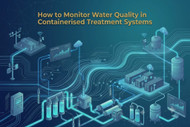
Containerised treatment systems are prefabricated, modular water treatment units installed inside standard shipping containers or purpose-built enclosures. These systems integrate treatment equipment, pumps, filtration units, chemical dosing equipment, instrumentation, controls, and piping into a compact, transportable package. In industrial applications, they can be deployed for process water treatment, industrial wastewater treatment, water reuse, pretreatment, and emergency or temporary treatment requirements.
Unlike conventional fixed treatment plants that require extensive civil construction and permanent infrastructure, containerised treatment systems are typically factory-assembled, pre-tested, and ready for relatively rapid deployment. Their modular design allows treatment capacity and processes to be configured according to the site's water quality, flow rate, treatment objectives, and available space.
This makes them particularly useful for industrial facilities where space is limited, treatment requirements change, or a temporary or mobile water treatment solution is required.
How Do Containerised Water Treatment Systems Work?
The water treatment process depends on the source water, required water quality, contaminants present, and intended end use. A typical system may combine several treatment stages, such as pre-filtration, chemical dosing, coagulation, sedimentation, media filtration, activated carbon filtration, membrane filtration, disinfection, and final water-quality monitoring.
How Does a Containerised Water Treatment System Operate?
The basic operating sequence typically follows these stages:
- Water intake: Raw water enters the containerised treatment system through an inlet connection. An initial screening or pre-filtration stage may remove larger particles and debris.
- Pre-treatment: Depending on the raw-water characteristics, the system may use cartridge filters, bag filters, multimedia filters, or chemical conditioning to reduce suspended solids and protect downstream equipment.
- Primary treatment: Treatment equipment is selected according to the contaminants that need to be removed. For example, media filtration can reduce suspended solids, while activated carbon can help remove certain organic compounds, taste, and odor.
- Advanced treatment: Where higher-quality water is required, technologies such as ultrafiltration (UF), nanofiltration (NF), or reverse osmosis (RO) can provide additional contaminant removal.
- Chemical treatment and disinfection: Chemical dosing systems may adjust water chemistry or add disinfectants. Depending on the application, systems may use chlorine-based disinfection, ultraviolet (UV) treatment, or other disinfection technologies.
- Water quality monitoring: Sensors and analytical instruments can continuously or periodically measure parameters such as pH, conductivity, turbidity, temperature, ORP, TDS, chlorine residual, and flow rate. Monitoring helps operators determine whether the treated water meets predefined operating or quality targets.
- Final water delivery: Once treatment is complete, the treated water is discharged, stored, or transferred to the next stage of the process or point of use.
Why Water Quality Monitoring is Important in Containerised Treatment Systems?
Water quality monitoring is a critical component of containerised water treatment plant because treatment performance can change as influent water conditions, flow rates, contaminant concentrations, and equipment operating conditions change.
Unlike conventional fixed treatment plants, containerised systems are often deployed in remote, temporary, decentralized, or variable operating environments. Continuous or periodic monitoring helps operators verify that the treatment process is performing as intended and that the treated water meets the required quality targets.
Equipment Is Used for Containerized Water Quality Monitoring
A typical containerized water quality monitoring system may include inline sensors for continuous measurement, portable meters for field verification, and control equipment that collects and processes measurement data.
Together, these components help operators evaluate treatment performance and identify changes that could affect water quality.
- pH Meters and pH Sensors
- Conductivity and TDS Meters
- Turbidity Sensors and Meters
- ORP Sensors
- Chlorine and Disinfectant Analyzers
- Temperature Sensors
- Flow Meters
- Multi-Parameter Monitoring Meters
The appropriate monitoring equipment depends on the treatment technology and water-quality objectives.
How Water Quality Monitoring Improves Treatment Control?
Water quality monitoring plays an important role in controlling the performance of containerised water treatment systems. Treatment conditions can change due to variations in influent water quality, flow rate, contaminant concentration, temperature, and equipment condition.
By continuously or periodically measuring critical parameters, operators can understand what is happening within the treatment process and make adjustments before water quality problems affect the final output.
- Detects treatment problems early
- Supports automated process control
- Improves filtration and membrane management
- Maintain consistent treated-water quality
- Reduces unnecessary chemical and maintenance costs
Common Water Quality Monitoring Challenges in Containerised Systems
Although containerised water treatment plant provide a compact and flexible approach to water treatment, maintaining reliable water quality monitoring can present several operational challenges.
Limited space, changing water conditions, environmental exposure, and integration with automated controls can all affect monitoring accuracy and system performance. Understanding these challenges helps operators develop a more reliable containerized water quality monitoring strategy.
- Limited installation space
- Changing influent water quality
- Calibration and measurement accuracy
- Temperature and environmental conditions
- Inadequate sample conditioning
- Integration with treatment controls
Best Practices for Containerised Water Quality Monitoring
Effective water quality monitoring is essential for maintaining reliable performance in containerised water treatment systems. Because these systems must be carefully planned and maintained.
Following established best practices helps operators obtain reliable measurements, identify process changes early, and maintain consistent treated-water quality.
- Identify the critical water quality parameters
- Monitor water quality at key treatment stages
- Use appropriate inline sensors
- Establish routine calibration program
- Inspect and clean sensors regularly
- Integrate monitoring with automated controls
The best approach to containerised water quality monitoring is to treat monitoring as an integral part of the treatment process rather than as a separate testing activity.
A well-planned containerised or portable water quality monitoring system enables operators to detect changes earlier, maintain consistent treated-water quality, protect treatment equipment, optimize chemical and maintenance activities, and improve the long-term reliability of the treatment system.