
Scale vs Corrosion in Water Systems: Causes and Differences
Posted by David Cannon on 15th Oct 2026
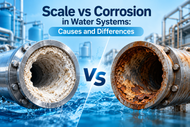
Scale and corrosion are two common problems in water systems, but they affect equipment in different ways. Scale deposits can restrict heat transfer, reduce flow through pipes, and impair equipment efficiency. Corrosion gradually degrades metal surfaces, potentially causing leaks, equipment damage, and water contamination. When both occur in the same system, diagnosing the underlying causes becomes more complicated.
Understanding the scaling and corrosion difference helps facility operators identify the source of performance issues and select appropriate treatment methods. However, controlling one problem without considering the other can create additional challenges.
For example, increasing pH may help control certain types of corrosion but can also promote mineral scale formation, depending on the water chemistry. This guide explains the causes of water system scale and corrosion, how to distinguish between them, and the water treatment approaches used to manage both.
What Are Scale and Corrosion in Water Systems?
The basic difference is simple: scale adds material to a surface, while corrosion degrades metal through chemical or electrochemical reactions.
- Scale: Scale consists of mineral deposits that form when dissolved substances in water precipitate out of solution and accumulate on equipment surfaces. Calcium carbonate is common, but calcium sulfate, silica, magnesium compounds, and calcium phosphate can also form deposits.
- Corrosion: Corrosion, on the other hand, is the deterioration of metal through reactions with its surrounding environment. Iron, for example, can form iron oxides or enter the water as dissolved metal ions.
Both problems can occur in boilers, cooling towers, closed loops, process water systems, and industrial HVAC equipment. Their effects and treatment requirements vary with the water chemistry, operating conditions, and materials in the system.
Scale vs Corrosion: What Is the Difference?
When comparing water scale vs corrosion, look at the mechanism, appearance, and effect on equipment.
|
Factor |
Scale |
Corrosion |
|
Mechanism |
Mineral precipitation and deposit accumulation |
Metal deterioration through chemical or electrochemical reactions |
|
Appearance |
White, tan, gray, or crusty deposits, depending on composition |
Rust, localized pits, metal thinning, or tubercles in some systems |
|
Common locations |
Hot surfaces, heat exchangers, boiler tubes, and cooling tower components |
Piping, tubes, welds, joints, and areas prone to localized corrosion |
|
Effect on equipment |
Reduced heat transfer and restricted flow |
Metal loss, leaks, perforation, and potential equipment failure |
|
Typical treatment |
Water softening, antiscalants, dispersants, and blowdown where applicable |
Corrosion inhibitors, dissolved oxygen control, and pH adjustment where appropriate |
Water chemistry and operating conditions can influence both processes. Temperature, mineral concentration, pH, dissolved oxygen, and other factors can change the likelihood of scale formation or corrosion. Some deposits can also conceal underlying corrosion, so visual inspection alone may not establish the cause.
Water Chemistry Factors That Cause Both Scaling and Corrosion
Several water chemistry factors and operating conditions affect the risk of scale formation and corrosion. Some are causes of scale in water systems, while others contribute to metal deterioration or affect both processes.
- pH and Alkalinity: Higher pH and alkalinity can increase carbonate scale potential. Low pH can accelerate the corrosion of susceptible metals, depending on the water chemistry and system materials.
- Water Hardness and Mineral Content: Calcium and magnesium contribute to water hardness. When water chemistry and temperature favor precipitation, calcium carbonate, calcium sulfate, and other mineral deposits can form on equipment surfaces. Silica and some sulfate deposits can be particularly difficult to remove.
- TDS and Conductivity: Total dissolved solids (TDS) indicate the concentration of dissolved substances, while conductivity reflects the water's ability to carry electrical current. Both can help monitor changes in recirculating water chemistry, but neither directly measures scaling or corrosion rates.
- Blowdown Control: Insufficient blowdown in cooling towers and boilers can allow dissolved solids to concentrate, increasing the risk of scale formation and potentially affecting corrosion control.
- Chemical Treatment Imbalance: Poorly controlled phosphate or other treatment programs can contribute to deposits or reduce corrosion control effectiveness. For example, calcium phosphate deposits may form when treatment conditions favor precipitation.
- High-temperature Surfaces: Elevated temperatures at heat-transfer surfaces can increase the likelihood of certain mineral deposits, particularly calcium carbonate scale, depending on the water chemistry.
- Dissolved Oxygen: Oxygen can drive corrosion in carbon steel and other susceptible metals, including in boiler feedwater systems and industrial piping.
- Dissimilar Metals: Galvanic corrosion can occur when dissimilar metals are electrically connected in the presence of conductive liquid.
- High Flow Velocity and Turbulence: Excessive velocity or turbulence can damage protective surface films and contribute to erosion-corrosion, particularly at elbows, restrictions, and other areas of disturbed flow.
- Microbial Activity: Biofilms can create localized chemical conditions that promote microbiologically influenced corrosion (MIC) on susceptible metal surfaces.
- Chemical Overfeeding: Excessive acid or improperly controlled treatment chemicals can alter pH and water chemistry, potentially increasing corrosion or promoting deposits.
- Chlorides and Sulfates: Chlorides can increase the risk of localized pitting and other forms of corrosion in susceptible metals. Sulfates can also contribute to corrosion under certain conditions and form mineral deposits when their concentrations and the water chemistry favor precipitation.
The Langelier Saturation Index (LSI) can help assess whether water is undersaturated or supersaturated with respect to calcium carbonate. A positive LSI indicates a tendency toward calcium carbonate precipitation, while a negative LSI indicates undersaturation. A value near zero indicates approximate equilibrium. LSI does not directly measure corrosion or predict corrosion rates, so it should be considered alongside other water chemistry parameters, system materials, and operating conditions.
How Scale and Corrosion Affect Water System Performance?
Scale can affect water system performance in several ways:
- Reduces heat transfer: Mineral deposits act as an insulating layer on heat-transfer surfaces, reducing thermal efficiency.
- Restricts flow: Deposits can narrow the internal diameter of pipes and equipment passages, increasing flow resistance.
- Increases energy use: Boilers and heat exchangers may require more energy to produce the same output when scale reduces heat-transfer efficiency
- Increases pumping requirements: Flow restrictions can increase pressure drop, requiring greater pumping effort to maintain the required flow rate.
- Interferes with sensors: Deposits can coat probes and other monitoring components, affecting measurement accuracy or equipment operation.
Corrosion can affect water systems in the following ways:
- Causes metal loss: General corrosion reduces wall thickness, while localized corrosion can create pits that penetrate metal surfaces.
- Causes leaks and failures: Advanced corrosion can result in pinhole leaks, tube failures, and equipment damage.
- Distributes corrosion products: Iron oxides and other corrosion products can circulate through the system and accumulate elsewhere, potentially restricting flow or fouling equipment.
- Increases replacement needs: Continued corrosion can shorten component service life and lead to premature replacement.
- Interrupts operations: Significant leaks, tube failures, and other corrosion-related damage can cause unplanned downtime.
Scale and corrosion can also affect water filtration systems. Mineral deposits, corrosion products, and suspended particles can accumulate in filter media or on filter surfaces, increasing pressure drop and, in some systems, shortening filter service intervals. Corrosion can also damage filter housings and associated piping, depending on the materials and operating conditions.
How to Identify Scale vs Corrosion in a Water System?
Here are steps to identify scaling and corrosion.
- Perform a visual inspection:
- Look for white, tan, or gray crusty deposits: These often indicate mineral scale.
- Check for rust-colored water: Red or orange material often indicates iron corrosion products.
- Inspect for pits and tubercles: These can indicate localized corrosion.
- Monitor heat-transfer performance: Increasing approach temperatures or declining heat-transfer efficiency may indicate scale or fouling.
- Check differential pressure: A rising pressure drop can indicate restricted flow from deposits.
- Test water samples: Hardness, alkalinity, pH, conductivity, iron, and copper can provide useful information.
- Perform a deposit analysis: This helps identify an unknown material. A small acid test may indicate carbonate scale because it can react and produce visible fizzing. However, this test does not identify every scale type.
- Use corrosion coupons to measure corrosion: Coupon racks expose metal samples to system water for a defined period. The resulting weight loss can be used to calculate corrosion rates in mils per year ( mpy).
Steps for Scale and Corrosion Prevention in Industrial Water Systems
Effective water treatment for scale and corrosion prevention usually requires several controls working together. The causes of corrosion in water systems and causes of scale in water systems must be addressed separately to achieve effective water treatment.
For scale:
- Reduce hardness: Use softening or other pretreatment where appropriate.
- Control deposits: Use antiscalants and dispersants when required.
- Control pH: Maintain chemistry within the treatment program's recommended range.
- Manage blowdown: Prevent excessive dissolved-solids concentration in cooling systems.
For corrosion:
- Use corrosion inhibitors: Select the inhibitor based on system chemistry and metal materials.
- Control oxygen: Boiler systems may require deaeration or oxygen scavengers.
- Maintain proper pH: Avoid conditions that promote metal attack.
- Review materials: Check compatibility when different metals are present.
For both:
- Control biological growth: Prevent biofilm growth that can contribute to fouling and corrosion.
- Feed chemicals accurately: Metering pumps and chemical feed systems help maintain consistent treatment.
Monitoring and Control: Keeping Treatment on Target
Water treatment only works if system conditions remain within the required range.
- Monitor conductivity: Helps control dissolved solids and cycles of concentration.
- Check pH and ORP: Useful for controlling specific treatment programs.
- Automate blowdown: Reduces the risk of excessive concentration in cooling towers and boilers.
- Use coupon racks: Track actual corrosion performance over time.
- Test routinely: Confirm that chemical residuals and water chemistry remain within target ranges.
- Track trends: Data logging can reveal gradual changes before they become equipment problems.
Conductivity controllers, water quality meters, and automated monitoring systems can reduce reliance on occasional manual checks and provide better operating data.
Scale vs Corrosion: How to Determine the Right Treatment Strategy?
Here’s how you can determine the right treatment strategy.
- Test the water: Check hardness, alkalinity, pH, conductivity, TDS, chloride, sulfate, iron, and copper as appropriate.
- Inspect the equipment: Look for deposits, pitting, leaks, fouling, and tube damage.
- Check operating conditions: Review temperature, flow, pressure drop, cycles of concentration, and chemical feed rates.
- Review corrosion data: Use coupon results to estimate general corrosion rates over time.
- Identify the primary risk: Determine whether scale, corrosion, or both are affecting the system.
- Adjust treatment: Select appropriate measures, such as filtration, softening, antiscalants, corrosion inhibitors, oxygen control, biocides, or blowdown, based on the findings.
If testing results do not explain observed system performance, a water treatment specialist can help identify the underlying cause.
Control Scale and Corrosion with the Right Treatment Program
Regular water testing, equipment inspection, corrosion monitoring, and proper chemical control can help manage scale and corrosion in industrial water systems. Cannon Water Technology provides water treatment chemicals, chemical feed equipment, controllers, test kits, corrosion coupon racks, and related equipment for boiler, cooling tower, filtration, and industrial water applications. Explore Cannon Water Technology’s product range to find the equipment and treatment solutions suited to your facility’s needs.
FAQs
- Can scale and corrosion occur at the same time?
Yes. Scale and biofilms can contribute to under-deposit corrosion by creating localized conditions that promote metal attack beneath deposits. Both problems can occur simultaneously in the same system.
- Does a water softener stop corrosion?
No. A softener removes calcium and magnesium hardness but does not automatically control dissolved oxygen, low pH, chloride-related corrosion, galvanic corrosion, or other corrosion mechanisms.
- How often should corrosion coupons be pulled?
Many monitoring programs use exposure periods of about 90 days, but the appropriate interval depends on the system, treatment program, and monitoring requirements.
- What is the fastest way to differentiate scale from rust?
Check the appearance first. White or tan crusty deposits often indicate scale, while reddish-brown material and pitting may indicate iron corrosion. Water and deposit testing can help confirm the cause.