
Industrial Water Recycling System: Centralized vs. Decentralized Solutions
Posted by David Cannon on 10th Sep 2026
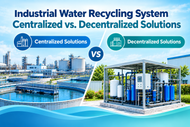
Industrial facilities generate wastewater streams that often vary in flow, contaminant characteristics, and treatment requirements. Industrial wastewater recycling systems help facilities treat wastewater and reuse it for suitable applications, reducing reliance on fresh water and supporting more efficient water management. Depending on facility size, process layout, water quality requirements, and available infrastructure, treatment may be organized around a centralized or decentralized approach.
A centralized system typically collects wastewater from multiple processes for treatment at a common location, while a decentralized approach treats water closer to where it is generated or reused. Understanding these differences can help facilities evaluate the approach that best fits their operational requirements. This post examines the key differences between centralized and decentralized water recycling systems and how facilities can determine the right approach.
How Centralized and Decentralized Water Recycling Systems Work?
Centralized and decentralized water treatment systems use different approaches to collect, treat, and reuse industrial wastewater. The main difference is where treatment takes place and how wastewater moves through the facility.
Centralized Water Recycling Systems: A centralized system collects wastewater from multiple production areas and sends it to a common treatment location. The collected water passes through one or more treatment stages selected to address the combined characteristics of the wastewater.
How it works:
- Collection: Wastewater from different processes is directed through a shared collection network.
- Treatment: The combined stream enters a central treatment system, where processes such as separation, filtration, or other treatment methods remove targeted contaminants.
- Water Reuse: Treated water is directed to suitable reuse applications or additional treatment, depending on the required water quality.
Decentralized Water Recycling Systems: A decentralized system treats wastewater closer to where it is generated or reused. Instead of directing all wastewater to one treatment plant, separate treatment units can be installed for individual processes, production areas, or groups of compatible wastewater streams.
How it works:
- Source Collection: Wastewater is collected near the process or production area where it is generated.
- Localized Treatment: A dedicated treatment unit addresses the specific characteristics and flow requirements of that wastewater stream.
- Local Water Reuse: Treated water can be returned to a nearby process or directed to another suitable reuse application.
Key Differences: Centralized vs. Decentralized Industrial Water Recycling Systems
The following pointers differentiate centralized water filtration systems from decentralized systems.
|
Factor |
Centralized System |
Decentralized System |
|
Piping and infrastructure |
May require extensive collection of piping and pumping required to move wastewater to the central facility. |
Requires minimal piping infrastructure as the distance wastewater travels between generation and treatment sources is less. |
|
Footprint |
Requires space for a central treatment area and associated collection infrastructure. |
Equipment is distributed across the facility and may require multiple installation locations. |
|
Scalability |
Expansion may involve increasing capacity at the central treatment facility. |
Additional treatment units can potentially be added closer to new process areas. |
|
Water quality |
Combined streams may require treatment based on the overall characteristics of wastewater. |
Individual streams can be treated according to their specific contaminant profile and reuse requirements. |
|
Operation and monitoring |
Centralized equipment can simplify oversight because major treatment processes are concentrated in one location. |
Multiple treatment locations may require more distributed monitoring and maintenance. |
|
Maintenance |
Maintenance activities are concentrated around the central treatment system. |
Maintenance requirements are distributed across multiple treatment units. |
|
Future expansion |
Capacity and collection infrastructure should be considered when adding new processes. |
Modular treatment options may provide flexibility for facilities expanding in separate areas. |
|
Best fit |
May suit facilities with compatible wastewater streams and practical centralized infrastructure. |
May suit facilities with separated processes, varying wastewater characteristics, or localized reuse requirements. |
|
Cost |
May involve higher upfront costs for centralized treatment equipment, collection piping, pumping, and supporting infrastructure. However, concentrating treatment in one location may simplify some operating and maintenance costs. |
Can reduce piping and pumping costs, particularly where treatment points are close to wastewater sources. However, multiple treatment units may increase equipment, monitoring, and maintenance costs. |
Industrial Applications of Centralized and Decentralized Water Recycling Systems
Centralized and decentralized systems find application across industries, depending on their wastewater treatment and water reuse needs.
Common applications include:
- Manufacturing: Large manufacturing facilities with multiple production lines may use centralized systems to collect and treat wastewater from several processes. Decentralized systems can work well when individual production lines generate wastewater with different characteristics or have localized reuse requirements.
- Food and Beverage Processing: Food and beverage facilities generate wastewater with varying organic loads, suspended solids, and cleaning-related contaminants. Centralized treatment can manage compatible streams across a facility, while decentralized treatment can address specific process streams before reuse or further treatment.
- Metal Finishing and Fabrication: Metalworking and finishing operations may generate wastewater containing suspended solids, oils, and process-specific contaminants. Decentralized treatment can address individual process streams, while centralized systems can manage compatible wastewater through a common treatment operation.
- Pharmaceutical Manufacturing: Pharmaceutical facilities may generate wastewater streams with different compositions and treatment requirements. Decentralized systems can provide process-specific treatment, while centralized systems can manage streams that can be safely combined.
- Power Generation: Power facilities may generate wastewater from cooling, equipment cleaning, and other plant operations. A centralized approach can support facility-wide treatment, while localized systems can address specific water streams before reuse.
- Chemical Processing: Chemical plants can produce wastewater with significantly different characteristics across production processes. Decentralized treatment may allow facilities to address individual streams according to their specific contaminants, while centralized treatment can handle compatible streams after appropriate pretreatment.
- Mining and Mineral Processing: Mining operations can generate large volumes of water containing suspended solids and process-related contaminants. Centralized systems can support treatment of large combined flows, while decentralized units may be useful near individual processing or water-use areas.
- Industrial Campuses and Multi-Building Facilities: Facilities with multiple buildings or geographically separated operations may combine both approaches. Centralized treatment can serve shared wastewater streams, while decentralized units can treat water closer to individual buildings or processes.
Build a Water Recycling System Around Your Process
Every industrial wastewater stream presents unique treatment challenges based on its contaminants, flow rates, and intended reuse. Cannon Water Technology provides filtration and separation solutions that can support both centralized and decentralized water treatment systems, helping facilities address specific process requirements and water quality targets.
Our solutions can be integrated into existing treatment processes or considered as part of a new water recycling system. Whether you are managing multiple wastewater streams or treating water closer to the point of generation, our team can help identify suitable treatment options.