
KNIGHT UMP Digital Plus for Door-Type Commercial Dishwashers | Setup & Application Guide
Posted by David Cannon on 25th Sep 2026
KNIGHT UMP Digital Plus for Door-Type Commercial Dishwashers
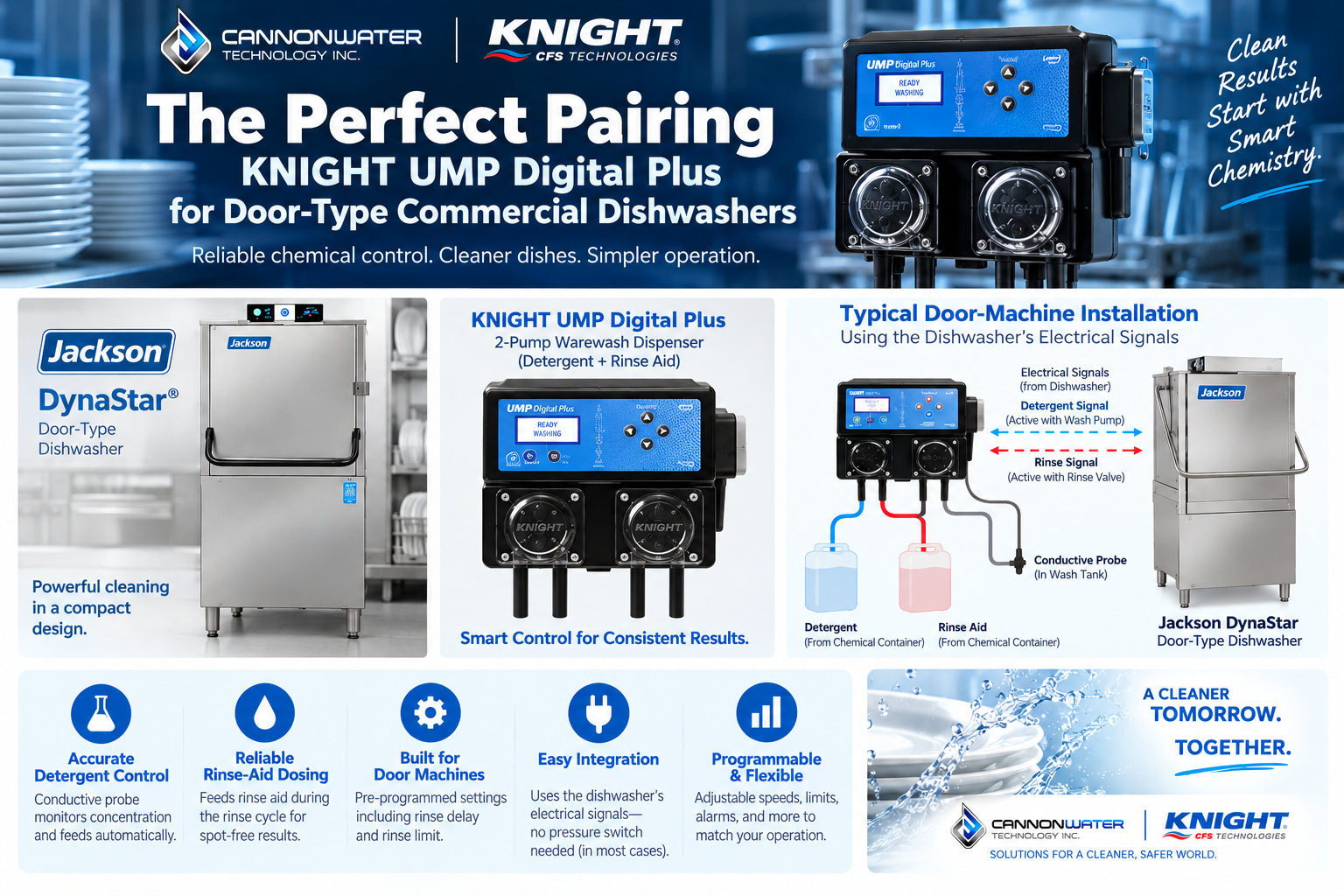
Commercial door-type dishwashers require accurate chemical dispensing to maintain detergent concentration, properly apply rinse aid, and deliver consistent warewashing results. A properly configured chemical dispenser should also work with the dishwasher's operating cycle rather than simply feeding chemicals on a fixed schedule.
The KNIGHT UMP Digital Plus is designed for commercial warewashing applications and can control liquid detergent and rinse aid while using electrical signals from the dish machine to determine when the machine is washing and rinsing.
In this application guide, we'll look at how the UMP Digital Plus can be configured for a typical door-style commercial dishwasher and use the Jackson DynaStar high-temperature door-type dishwasher as a real-world example.
View the KNIGHT UMP Digital Plus 200L Two-Pump Warewash Dispenser
Why the UMP Digital Plus Works Well with Door-Type Dish Machines
The UMP Digital Plus is more than a pair of chemical pumps. It is a programmable warewash chemical dispensing controller that can coordinate detergent and rinse-aid delivery with the operating cycle of the dishwasher.
For a typical two-product liquid chemical system, the UMP Digital Plus can be configured with:
- A liquid detergent peristaltic pump
- A liquid rinse-aid peristaltic pump
- A conductive detergent concentration probe
- Detergent and rinse electrical signal inputs
- Programmable pump speeds, delays, limits, alarms, and operating parameters
The UMP Digital Plus accepts detergent and rinse trigger signals over a wide 14–480 VAC range, allowing it to interface with many commercial dish machines.
How a Two-Pump Warewash Chemical Dispenser Works
A typical door-machine installation uses two separate chemical circuits: detergent and rinse aid.
Detergent Control
Liquid detergent is pumped into the dishwasher's wash tank. When the UMP Digital Plus is configured for probe operation, a conductive probe installed in the wash tank monitors detergent concentration.
When detergent concentration falls below the programmed setpoint, the UMP activates the detergent pump. As concentration approaches the target, the controller can pulse the detergent feed to help prevent excessive chemical addition.
This provides closed-loop detergent concentration control rather than relying only on a predetermined number of seconds of detergent feed.
Rinse-Aid Control
Rinse aid is normally injected into the dishwasher's final rinse line. When the dishwasher begins its rinse cycle, its rinse signal activates the corresponding input on the UMP Digital Plus.
The UMP then operates the rinse-aid pump according to its programmed settings. Pump speed can be adjusted to calibrate chemical delivery for the rinse product and dish machine.
For door-style machines, the UMP also provides programmable rinse delay and rinse limit functions that can help optimize rinse-aid consumption.
Using the Dishwasher's Electrical Signals as Triggers
Many modern commercial dishwashers provide electrical connections specifically for external chemical dispensing equipment.
When these connections are available, they are generally preferable to adding external sensing devices because the dispenser can receive its operating signals directly from the dishwasher.
A typical installation looks like this:
| Dishwasher Function | UMP Digital Plus Input | Purpose |
|---|---|---|
| Wash / Detergent Signal | Detergent Signal Input | Indicates the machine is in the appropriate detergent-feed cycle |
| Rinse Signal | Rinse Signal Input | Activates rinse-aid dispensing during the rinse cycle |
The UMP Digital Plus accepts a 14–480 VAC detergent signal and a 14–480 VAC rinse signal. This broad input range makes the controller compatible with many different commercial dishwasher electrical configurations.
Probe vs. Probeless Detergent Control
The UMP Digital Plus supports both probe and probeless detergent control.
Probe Mode
In probe mode, a conductive or inductive probe monitors detergent concentration in the wash tank. When concentration falls below the programmed setpoint, the controller feeds detergent until the desired concentration is restored.
For many liquid-detergent door-machine applications, this provides a very effective method of maintaining chemical concentration as operating conditions change.
Probeless Mode
The UMP can also control detergent without a concentration probe. In probeless operation, an initial charge establishes detergent concentration when the machine is filled with fresh water. Subsequent recharge feeds replace detergent as rinse water enters the wash tank and dilutes the solution.
This gives installers flexibility when a conductivity probe is not appropriate for the detergent chemistry or application.
Do You Need a Pressure Switch?
Not necessarily.
If the dishwasher provides a dedicated electrical rinse signal, the UMP Digital Plus can use that signal directly.
KNIGHT provides a pressure-switch option for applications where the dishwasher does not provide a suitable dedicated rinse signal. The pressure switch detects operation of the rinse system and creates a trigger for the dispenser.
Therefore, before specifying a pressure switch, check the dishwasher manufacturer's electrical documentation. If a suitable chemical dispenser rinse output is already available, an additional pressure switch may not be necessary.
Real-World Example: Jackson DynaStar Door-Type Dishwasher
The Jackson DynaStar provides a good example of integrating a modern door-style dishwasher with the KNIGHT UMP Digital Plus.
The DynaStar is a high-temperature sanitizing door-type dishwasher rated for up to 62 racks per hour. The machine includes provisions for external chemical dispensing equipment, including detergent and rinse-aid connections and a detergent/rinse additive signal connection fuse box.
Jackson identifies the chemical connections on the machine as:
- D – Detergent Connection
- E – Rinse-Aid Connection
This makes the DynaStar well suited for a two-product KNIGHT UMP Digital Plus installation.
Recommended UMP Digital Plus Configuration for a Jackson DynaStar
For a typical liquid detergent and rinse-aid application, a practical starting configuration would be:
| UMP Setting | Configuration |
|---|---|
| Machine Type | Door |
| Detergent Mode | Probe |
| Detergent Chemical | Liquid |
| Detergent Control | Conductive probe |
| Detergent Trigger | Dishwasher detergent / wash signal |
| Rinse-Aid Trigger | Dishwasher rinse signal |
| Pressure Switch | Generally not required when a suitable dedicated rinse signal is available |
These settings should be considered a starting point. Final detergent concentration, pump speed, rinse-aid dosage, delay, and limit settings should be commissioned according to the chemical manufacturer's recommendations and actual operating conditions.
Where Should the UMP Digital Plus Be Installed?
Proper dispenser location is important. KNIGHT recommends keeping the dispenser within approximately three feet of the final rinse line to avoid unnecessarily long tubing runs.
The dispenser should not be mounted directly in the path of steam or in a location where dishwasher heat can damage the electronics or cause thermal overload.
Liquid Detergent Injection
Liquid detergent is typically injected through a bulkhead fitting into the wash tank above the normal water level.
Rinse-Aid Injection
Rinse aid is injected into the final rinse line between the rinse control valve and the rinse jets.
Conductive Probe Location
When a conductive detergent probe is used, KNIGHT recommends installing it below the wash-tank water level, away from incoming water and approximately 3–4 inches from corners, heating elements, and the bottom of the tank.
Why Use a Programmable Warewash Dispenser?
A properly configured chemical dispensing system can provide several advantages over simple fixed-rate chemical pumps:
- More consistent detergent concentration
- Automatic response to changing wash-tank conditions
- Adjustable rinse-aid feed rates
- Reduced risk of unnecessary chemical consumption
- Detergent concentration alarms
- Programmable rinse delay and rinse limits
- Tube-life monitoring and maintenance indicators
- Rack and operating counters
The result is a dispensing system that works with the commercial dishwasher instead of operating independently from it.
Choosing the Correct UMP Digital Plus Configuration
Before selecting a warewash chemical dispenser, gather the following information:
- Dishwasher manufacturer and model
- Door-type or conveyor-type machine
- Dishwasher electrical configuration
- Available detergent and rinse trigger signals
- Liquid, solid, or powder detergent
- Whether conductivity-based detergent control is appropriate
- Detergent and rinse-aid manufacturer's recommended feed rates
Reviewing this information before installation can help determine the correct dispenser, pump configuration, triggering method, probe, and accessories.
Need Help Selecting a Commercial Dishwasher Chemical Dispenser?
Cannon Water Technology supplies KNIGHT chemical dispensing equipment for commercial warewashing and other chemical feed applications.
Our team can help evaluate your dish machine and application to determine the appropriate UMP Digital Plus configuration, pumps, probes, triggering method, and accessories.
Have your dishwasher manufacturer and model number available? Send it to us and we can help determine the appropriate dispensing configuration.
View the KNIGHT UMP Digital Plus 200L Warewash Dispenser
Cannon Water Technology, Inc.
Solutions for water treatment, chemical feed, instrumentation, and process control.
Installation and electrical connections should be performed by qualified personnel in accordance with the dishwasher and dispenser manufacturers' instructions and applicable electrical and plumbing codes. Verify signal voltages and connection points on the specific dish machine before making electrical connections.