
Vacuum Evaporators for Wastewater: Turning Complex Waste Streams into Manageable Solutions
Posted by David Cannon on 23rd Sep 2026
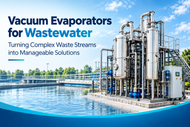
Industrial wastewater can contain high concentrations of dissolved salts, metals, oils, chemicals, and other contaminants that make treatment, discharge, and disposal increasingly challenging. For many facilities, managing these complex waste streams while controlling disposal costs and meeting water-reuse goals requires more than conventional treatment alone. Vacuum evaporation provides an alternative approach by separating water from dissolved and suspended contaminants, producing a distilled water stream and a concentrated residual stream.
Depending on the wastewater characteristics and system design, this can reduce the volume of liquid waste requiring further treatment or disposal. It can also contribute to water recovery and broader wastewater minimization strategies. This post explores how vacuum evaporation works in industrial wastewater treatment, where it is commonly used, and the key factors that influence system performance.
What Is a Vacuum Evaporator?
A vacuum evaporator is a thermal separation system used to concentrate industrial wastewater by removing a portion of its water as vapor under reduced pressure. Unlike treatment methods that chemically destroy or convert contaminants, evaporation primarily separates water from less volatile dissolved substances and suspended solids.
An industrial vacuum evaporator typically produces two output streams:
- Distillate: The liquid produced when evaporated water vapor is cooled and condensed. Its quality depends on the composition of the wastewater, particularly the presence of volatile compounds, and may require further treatment before reuse or discharge.
- Concentrate: A reduced-volume stream containing higher concentrations of salts, dissolved metals, suspended solids, oils, and other less volatile contaminants originally present in the wastewater.
This concentration function makes a wastewater evaporator particularly useful when reducing liquid waste volume or recovering water is a key treatment objective.
How Does a Vacuum Evaporator Work?
A vacuum evaporator system uses reduced pressure, heat, evaporation, and condensation to separate water from less volatile contaminants in industrial wastewater. While equipment configurations vary, the process generally involves the following stages:
- Wastewater Feed and Pretreatment: Wastewater is transferred to the evaporator. Depending on its composition, pretreatment such as filtration, oil separation, pH adjustment, or chemical conditioning may be used to reduce suspended solids, scaling, fouling, or foaming that could affect evaporator performance.
- Vacuum Creation and Heating: A vacuum is established inside the evaporation chamber, reducing the pressure and lowering the boiling temperature of water. Heat is then supplied to provide the energy needed for evaporation at a lower temperature than would be required under atmospheric pressure.
- Evaporation and Concentration: As water evaporates, nonvolatile and less volatile contaminants remain in the liquid phase and become progressively concentrated. The evaporation process continues until the system reaches its specified concentration level or other defined operating endpoint.
- Vapor Separation and Condensation: Before condensation, the vapor may pass through a droplet separator or demister to reduce the carryover of entrained liquid droplets. It is then cooled and condensed back into liquid distillate. Depending on the industrial vacuum evaporator design, heat may also be recovered and reused within the process to reduce energy consumption.
- Concentrate Removal: The concentrated residual stream is removed either continuously or periodically, depending on the system design. Based on its composition, it may undergo further treatment, resource recovery, or appropriate disposal.
Benefits of Vacuum Evaporation for Industrial Wastewater
When properly selected and operated, a vacuum evaporator for wastewater can provide several benefits as part of an industrial wastewater management strategy:
- Reduced Wastewater Volume: By evaporating and recovering water, the system concentrates less volatile contaminants into a smaller residual stream, which can reduce the volume requiring further treatment, transport, or disposal.
- Potential for Water Recovery and Reuse: The generated vapor is condensed into distillate that may be reused directly or after additional treatment, depending on its quality and the requirements of the intended application.
- Management of Concentrated Waste Streams: An industrial vacuum evaporator can be used to treat certain high-TDS and high-strength wastewater streams that may present challenges for conventional treatment processes.
- Support for Wastewater Minimization and ZLD: A vacuum evaporator system can recover water from suitable wastewater streams while reducing the remaining liquid waste volume, making evaporation a potential component of wastewater-minimization strategies and ZLD treatment trains.
- Potentially Lower Waste Disposal Costs: Reducing the volume of residual wastewater can lower off-site hauling, handling, and disposal requirements when these costs are based partly on waste volume.
Preparing Industrial Wastewater for Vacuum Evaporation
The composition of wastewater entering a vacuum evaporator can affect heat transfer, operating stability, cleaning frequency, and distillate quality. For this reason, the feed stream should be characterized before selecting the vacuum evaporator system and determining whether pretreatment is necessary.
Depending on the wastewater characteristics, pretreatment may include:
- Suspended solids removal: Filtration or solids separation can reduce particulate buildup that may contribute to fouling or affect equipment operation.
- Oil and grease separation: Free oils and some emulsified oils may need to be removed or conditioned to help control fouling and foaming.
- pH adjustment: Controlling pH can help manage corrosion, scaling, and the behavior of certain dissolved compounds during evaporation.
- Scale control: Wastewater containing scale-forming salts may require chemical conditioning or other pretreatment to limit deposits on heat-transfer surfaces.
- Foam control: Waste streams prone to foaming may require operational adjustments or suitable antifoam treatment to reduce liquid carryover into the vapor stream.
Equipment and Processes Used to Prepare Wastewater for Vacuum Evaporation
Here are the key equipment and processes used to prepare industrial wastewater for vacuum evaporation:
- Centrifugal Separators: Centrifugal separators use centrifugal force to separate suspended particles or immiscible liquid phases based on differences in density. Depending on the equipment design, they can be useful for wastewater containing sand, grit, metal fines, and other relatively dense particles.
- Cartridge and Bag Filtration Systems: Cartridge and bag filters provide a physical barrier for removing suspended particles before wastewater enters the evaporator. Different filter media, micron ratings, housing configurations, and flow capacities allow filtration to be matched to the required solids-removal level.
- Emulsion Breakers: Industrial wastewater from machining, metalworking, degreasing, and parts washing may contain stable oil-water emulsions. Emulsion breakers, also known as demulsifiers, chemically destabilize certain emulsions, allowing oil and water phases to separate more readily.
- Chemical Metering Pumps and Dosing Systems: Before wastewater enters a vacuum evaporator, controlled chemical dosing may be used to adjust pH, manage scale-forming constituents, or support coagulation and flocculation where required by the pretreatment process. Chemical metering pumps provide controlled chemical injection, which can help maintain feed conditions and manage factors that contribute to scaling, fouling, and other operating problems within the evaporator.
- Chemical Storage Tanks and Mixers: Chemical-resistant storage tanks provide containment for treatment chemicals and prepared solutions, while mixers promote uniform chemical distribution. Depending on the process, mixing systems can support chemical preparation, pH adjustment, coagulation, and other conditioning steps.
- Water Quality Meters and Controllers: Monitoring instruments allow operators to track changes in wastewater characteristics and adjust treatment accordingly. pH, ORP, conductivity, TDS, and multiparameter instruments can provide measurements relevant to chemical conditioning and dissolved-solids management.
Using the appropriate combination of separation, filtration, chemical conditioning, mixing, and monitoring can help create a more stable feed stream for an industrial vacuum evaporator, which can reduce avoidable process disturbances and support more consistent operation.
Where Are Vacuum Evaporators Used in Industrial Wastewater Treatment?
Common applications of wastewater evaporators include:
- Metal Finishing and Plating: A vacuum evaporator for wastewater can concentrate rinse and process streams containing dissolved metals, salts, and treatment chemicals by removing water as vapor.
- Machining and Parts Cleaning: After appropriate oil removal and pretreatment, an industrial vacuum evaporator can reduce the volume of wastewater generated by washing, degreasing, and metalworking operations, producing a concentrated residual stream for further treatment or disposal.
- Electronics and Semiconductor Manufacturing: A wastewater evaporator can treat suitable rinse and process streams containing dissolved salts, metals, acids, alkalis, and other manufacturing residues while reducing wastewater volume.
- Food and Beverage Processing: An industrial vacuum evaporator can reduce the volume of selected process wastewater streams containing dissolved organic and inorganic constituents while recovering water for potential further treatment or reuse.
Key Factors Affecting Vacuum Evaporator Performance
The performance of an industrial vacuum evaporator depends on both wastewater characteristics and operating conditions. Key factors include:
- Feed composition and concentration: Dissolved solids, volatile compounds, oils, and other constituents influence evaporation behavior, concentrate characteristics, and distillate quality.
- Vacuum level: Maintaining the required pressure is essential for achieving the intended boiling temperature. Air leaks or insufficient vacuum can increase the boiling temperature and affect evaporation performance.
- Heat-transfer efficiency: Scale, fouling, or deposits on heat-transfer surfaces can restrict heat flow and reduce heat-transfer performance and evaporation capacity.
- Feed rate and concentration target: The amount of wastewater entering the system and the desired final concentration must be compatible with the evaporator's design capacity and operating limits.
- Foaming and entrainment: Excessive foaming or liquid-droplet carryover can affect separation and reduce distillate quality.
- Energy efficiency: System configuration, heat recovery, operating temperature, and equipment condition influence the energy required to evaporate a given quantity of water.
Evaluate Your Industrial Wastewater Treatment Options
Choosing an appropriate wastewater treatment approach depends on waste composition, treatment objectives, water-recovery requirements, and operating conditions. Evaluate vacuum evaporation alongside other treatment and separation technologies to determine which approach fits your application. Proper wastewater characterization and process evaluation can help identify suitable treatment options and avoid unnecessary operating or disposal challenges. For more information on industrial wastewater treatment solutions, explore Cannon Water Technology’s water and wastewater treatment resources.