
What Is Activated Carbon Filtration? How It Works and What It Removes?
Posted by David Cannon on 11th Nov 2026
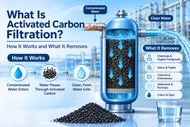
Free chlorine, chloramines, and dissolved organic compounds can pass through conventional sediment filters with little or no reduction. However, these contaminants can affect downstream water treatment equipment and treated water quality. Free chlorine, for example, can damage reverse osmosis (RO) membranes, particularly those made from polyamide, and degrade certain ion exchange resins. Dissolved organics can contribute to fouling, while chlorine and other compounds can cause unwanted taste and odor in treated water.
Activated carbon filtration addresses these treatment requirements through adsorption and, in the case of free chlorine, chemical reduction. It is widely used as a pretreatment step in commercial and industrial water treatment systems. The process helps reduce selected contaminants before water reaches sensitive equipment or enters a production process.
This post explains how activated carbon filtration works, what contaminants it removes, where it fits in industrial applications, and what engineers should consider when selecting an activated carbon filtration system.
What Is Activated Carbon Filtration?
Activated carbon filtration is a water treatment process that uses porous carbon media to reduce dissolved organic compounds, free chlorine, and certain other contaminants through adsorption and chemical reactions. The carbon provides a large internal surface area where certain dissolved substances can attach as water passes through the media.
Activated carbon is produced from carbon-rich materials such as coconut shells, coal, and wood. These materials undergo physical or chemical activation processes involving heat, steam, carbon dioxide, or selected chemical agents. Activation develops an extensive network of pores within the carbon structure, increasing its internal surface area and creating sites for contaminant adsorption.
The pore structure, surface chemistry, and adsorption characteristics depend on the raw material and activation process. Consequently, different activated carbon products vary in their ability to reduce specific contaminants. Selecting suitable carbon media requires considering the target contaminants, water chemistry, and treatment requirements.
Common Types of Activated Carbon Filters Used for Water Treatment
Activated carbon is available in several physical forms, each suited to different treatment arrangements.
- Granular Activated Carbon (GAC): GAC consists of relatively large carbon particles. It is commonly installed in pressure vessels or fixed-bed contactors through which water flows continuously. Industrial systems often use this form because it allows practical operation, media replacement, and backwashing where the equipment is designed for it.
- Powdered Activated Carbon (PAC): PAC consists of fine carbon particles that are added to water streams or treatment basins. The carbon adsorbs contaminants during contact and is subsequently removed through clarification or filtration.
- Carbon Block Cartridges: Carbon is formed into a rigid, porous block, typically using binders and compression or molding processes, for cartridge-based filtration. These units are commonly used in smaller-flow applications and point-of-use systems. Depending on their design and specifications, carbon block cartridges can provide both particulate filtration and reduction of selected dissolved contaminants.
How Activated Carbon Filtration Works?
The following mechanisms and operating factors determine how effectively activated carbon removes contaminants from water.
- Water Passes Through the Activated Carbon Media: Untreated water enters a vessel or cartridge containing activated carbon and flows through the porous media. In granular activated carbon (GAC) systems, water passes through a packed carbon bed, while carbon block cartridges direct water through a porous carbon structure.
The flow rate and media configuration influence how effectively water contacts the carbon surface. Adequate contact between water and carbon is necessary for contaminant removal.
- Dissolved Contaminants are Adsorbed: As water contacts the carbon, certain dissolved organic compounds attach to its external surface and internal pore walls through adsorption. This differs from absorption, which involves a substance entering the bulk structure of another material.
The distribution of these pores influences adsorption capacity and the rate at which contaminants reach available adsorption sites. Therefore, selecting carbon based on its surface area alone is insufficient. Its pore structure must match the target contaminants and treatment requirements.
- Chlorine Is Reduced Through Surface Reactions: Activated carbon removes free chlorine through surface-mediated chemical reduction, converting it primarily into chloride. This process differs from the adsorption of organic compounds.
Chloramines, particularly monochloramine commonly used in municipal water disinfection, generally react more slowly with conventional activated carbon than free chlorine. Their removal may require longer contact times or specialized catalytic activated carbon designed to improve reaction rates. Media selection and system sizing are particularly important when treating chloramine-disinfected municipal water.
- Contact Time Influences Treatment Performance: The time water spends in contact with activated carbon affects contaminant removal. In fixed-bed systems, Empty Bed Contact Time (EBCT) is calculated by dividing the carbon bed volume by the volumetric flow rate.
A longer EBCT generally provides more opportunity for adsorption and surface reactions, although actual treatment performance also depends on contaminant concentration, water chemistry, carbon properties, and flow distribution.
System designers use EBCT alongside media specifications and treatment requirements to determine suitable carbon bed dimensions and operating flow rates.
- Contaminant Breakthrough Indicates the Need for Media Servicing: As a carbon bed continues treating water, its available adsorption capacity for specific contaminants gradually decreases. The mass transfer zone, where adsorption is actively occurring, progresses through the bed toward the outlet.
Breakthrough occurs when a target contaminant begins appearing in treated water at a measurable or specified concentration. Monitoring the treated water helps operators identify when the carbon is no longer meeting the required removal performance.
Depending on the system and carbon media, corrective action may involve carbon replacement, regeneration, or adjustments to operating conditions. For contaminants removed through surface reactions, such as free chlorine, breakthrough behavior also depends on reaction kinetics and available reactive surface sites.
What Activated Carbon Removes and What It Does Not?
Activated carbon filtration can reduce several contaminants that affect industrial water quality. However, its performance varies with the carbon type, operating conditions, influent concentration, and competing substances.
- Contaminants It Handles Well: Activated carbon can reduce several organic contaminants and disinfectants commonly found in industrial and municipal water supplies. Its effectiveness depends on carbon characteristics, water chemistry, and operating conditions.
- Free Chlorine: Activated carbon effectively reduces free chlorine through a chemical reduction reaction at the carbon surface. It is commonly used to protect chlorine-sensitive RO membranes and certain ion exchange resins from chlorine-related damage.
- Volatile Organic Compounds (VOCs): Activated carbon can adsorb many VOCs, including certain industrial solvents and fuel-related compounds. Removal efficiency depends on the specific compound, carbon pore structure, and contact time.
- Pesticides: Many organic pesticides can be adsorbed by activated carbon. However, removal varies with molecular structure, solubility, and the type of carbon used.
- Taste and Odor Compounds: Activated carbon helps reduce certain organic compounds responsible for unpleasant taste and odor in water. It is commonly used in municipal and process water treatment.
- Natural Organic Matter and Disinfection Byproduct Precursors: Activated carbon can reduce adsorbable fractions of natural organic matter, including certain compounds that react with disinfectants to form disinfection byproducts (DBPs). The extent of removal depends on the composition of the incoming water, carbon properties, and operating conditions.
For systems where chlorine reduction is the primary objective, dedicated chlorine filters may be relevant. Media selection should account for the disinfectant concentration, water flow, and required residual at the outlet.
- Contaminants With Partial or Conditional Removal: Some contaminants require more careful evaluation before activated carbon is selected.
- Chloramine: Conventional activated carbon can reduce chloramines, but removal is generally slower than free chlorine reduction. Catalytic activated carbon may improve reaction rates and reduce the contact time required to achieve a specified treatment objective. Performance depends on carbon properties, water chemistry, and system design.
- Certain metals: Conventional activated carbon is not a reliable general-purpose treatment for dissolved metals. Some carbon media can retain specific metals under suitable conditions, while impregnated or chemically modified carbon may provide improved removal for selected contaminants, such as mercury. Media selection should be supported by contaminant-specific performance data.
- Per- and Polyfluoroalkyl Substances (PFAS): Granular activated carbon can remove certain PFAS, particularly longer-chain compounds such as PFOA and PFOS. Shorter-chain PFAS are often less effectively retained and may break through earlier. Removal depends on carbon properties, contact time, competing contaminants, and water quality. Compound-specific performance evaluation and breakthrough monitoring are important for determining carbon replacement or regeneration requirements.
- Contaminants It Does Not Remove: Conventional activated carbon filtration is not designed to provide substantial removal of several dissolved inorganic contaminants or to serve as a stand-alone disinfection process. It does not reliably remove:
- Hardness minerals: Calcium and magnesium generally require ion exchange softening or another suitable hardness treatment process.
- Dissolved salts and TDS: Activated carbon does not provide substantial reduction of total dissolved solids. Reverse osmosis is commonly used for this purpose.
- Nitrate: Conventional activated carbon is not an effective treatment for nitrate removal.
- Most Dissolved Inorganic Ions: Ions such as chloride and sulfate are not substantially removed by conventional activated carbon and generally require other treatment methods.
- Microorganisms: A conventional carbon bed is not a disinfection system. Microbial control requires an appropriate disinfection or validated microbial filtration process. Carbon beds can also support microbial growth if they are not properly operated and maintained.
For dissolved solids and ionic contaminants, reverse osmosis filtration systems can be considered as part of a broader treatment arrangement. Additional treatment stages may be required when the water contains contaminants that activated carbon cannot adequately reduce.
Applications of Activated Carbon Filters in Industrial Water Treatment
These are some common application areas.
- Water Treatment Plant: Municipal and industrial water treatment plants use activated carbon to reduce taste and odor compounds, selected dissolved organic contaminants, and certain disinfection byproduct precursors. Carbon filtration may also be used for dichlorination when downstream treatment processes require low chlorine concentrations.
- Boiler Makeup Water: Residual chlorine and other oxidants in boiler makeup water can degrade susceptible ion exchange resins. Activated carbon filtration helps remove residual chlorine before water enters softening and demineralization systems, where oxidant removal is required to protect the resin.
- RO and Membrane Pretreatment: Free chlorine can damage polyamide RO membranes through oxidation. Installing an activated carbon filter before the RO unit helps reduce chlorine exposure and protects membrane performance. Monitoring the carbon filter outlet for residual oxidants is important to verify adequate dechlorination. Where carbon filtration is impractical, chemical dichlorination using a suitable reducing agent may be considered, subject to membrane and system requirements.
- Cooling System Makeup Water: Activated carbon can treat cooling tower makeup water to reduce chlorine and selected organic compounds when these substances interfere with downstream treatment objectives. However, carbon treatment must be coordinated with the cooling system's biocide program to avoid unintentionally removing disinfectant residuals needed for microbial control.
- Process Water and Wastewater Polishing: Food and beverage facilities use activated carbon to reduce unwanted taste, odor, color, and selected organic compounds in process water. Chemical manufacturers may use it to remove specific organics, while wastewater treatment facilities can apply carbon as a final polishing step to reduce residual organic contaminants after upstream treatment has addressed the bulk contaminant load.
Where carbon filtration is impractical for chlorine removal, chemical dechlorination using a suitable chlorine neutralizer may be considered as an alternative.
Choose the Right Activated Carbon Filter for Your Water Treatment Needs
Need to reduce chlorine, dissolved organic compounds, or unwanted taste and odor in your water supply? Cannon Water Technology offers commercial and industrial water treatment equipment, including filtration systems and filter media for different treatment requirements.
Explore our water filtration systems and filter media range for suitable treatment equipment and components and contact us for a quote or any further information. Contact Cannon Water Technology today to discuss your contaminant removal goals, flow requirements, and operating conditions, and request a quote for an appropriate activated carbon filtration solution.