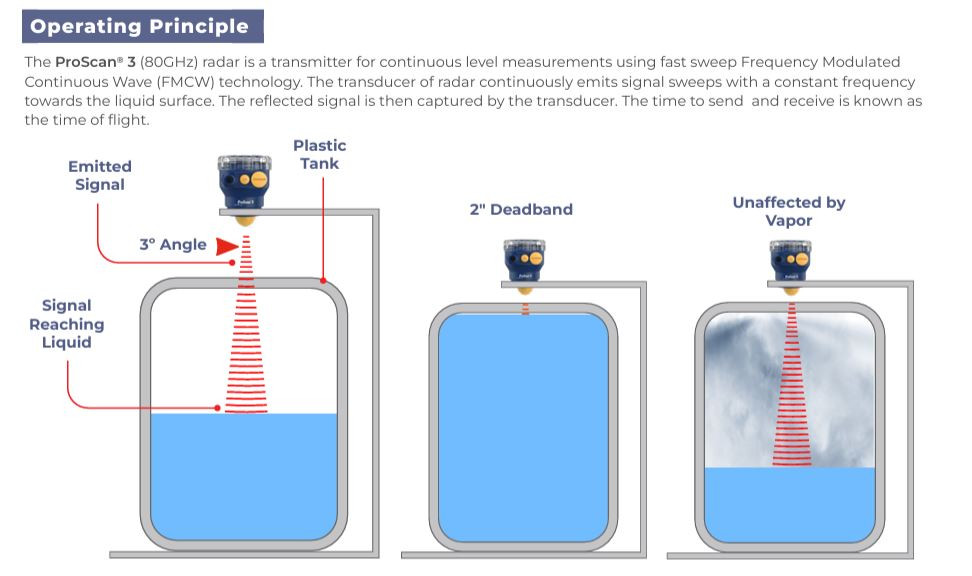
The ProScan®3 80 GHz high-frequency technology permits a significantly more precise transmission signal focus. This makes it easier to distinguish between actual level signals and interference signals, making the measurement more reliable coupled with a higher degree of accuracy. The new ProScan®3 series of compact instruments are ideally suited for more complex level applications.
The 80 GHz radar signal is capable of penetrating through the top lid of a plastic tank, no need to cut holes, simply set the sensor onto the tank or mount it above the tank and slide into place. Perfect for IBC Totes that need to be changed out frequently.

Features
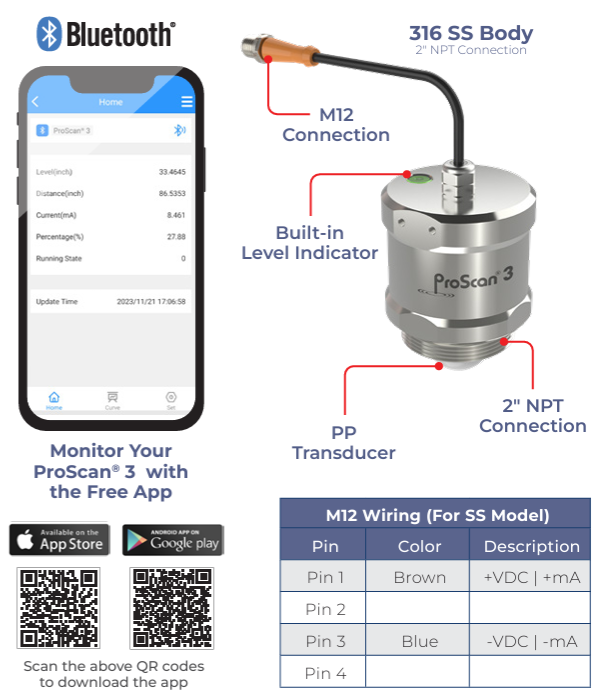
- Bluetooth Connectivity (30m | 100')
- Excellent Reliability and Accuracy
- Not Affected by Vapor or Outgassing
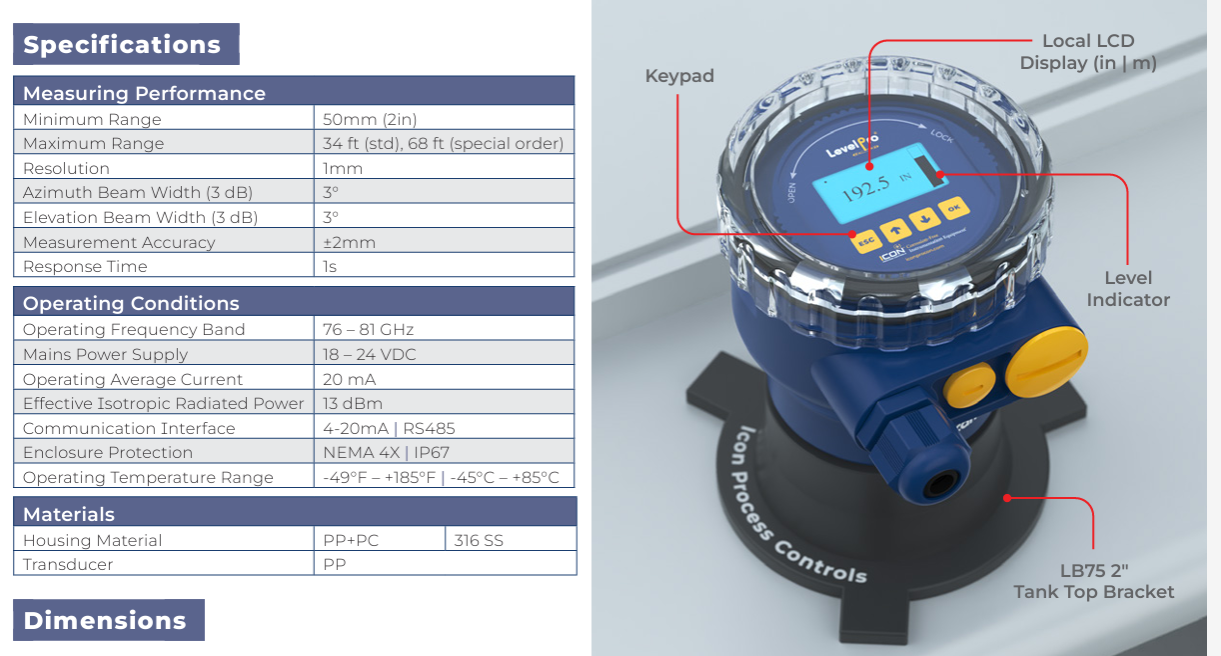
- RS-485 Communication | 4–20mA
- Measurement Under Vacuum | High Pressure
- Unaffected by Temperature Fluctuations
- NEMA 4X | Suitable for Outdoors
The Future of Non-Contact Level Measurement is Radar Technology!
The ProScan® 3 80 GHz high frequency technology permits a significantly more precise transmission signal focus. This makes it easier to distinguish between actual level signals and interference signals, making the measurement more reliable coupled with a higher degree of accuracy. The new ProScan® 3 series of compact instruments are ideally suited for more complex level applications.
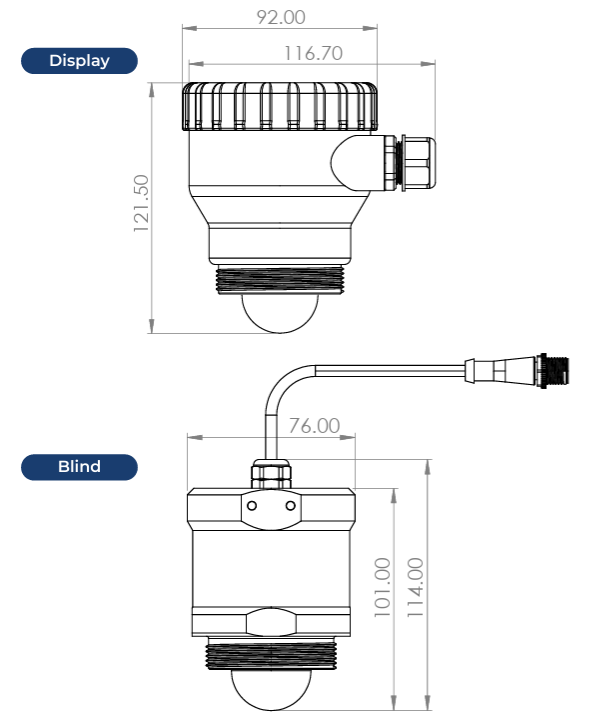
Advantages of Measuring Top of Tank
High Purity Liquids
In high purity applications, measuring through the vessel eliminates any concerns the sensor or process connection could contaminate the material inside.
Highly Corrosive Material
Often, highly corrosive materials are stored in plastic vessels. If the tank does not have to be opened there is less risk of material leaking or off-gassing from the vessel. Additionally, the level sensor does not have to be constructed of exotic materials in order to function in a hostile measuring environment.
High Temperature or Pressure Vessels
Measuring through the top of vessels allows for radar to be used on vessels that exceed the temperature and pressure specifications of the radar transducer
Mounting Considerations
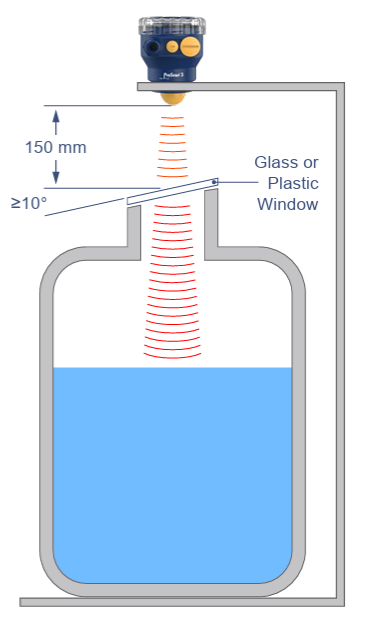
Sight glasses inclined at least 10º are preferred. This is so that energy that does not penetrate the glass will reflect away from the sensor. The narrow beam (3º) of the 80 GHz ProScan® 3 allows mounting above a sight glass and above a tall nozzle. Make sure that there is a clear path for the reflected energy to travel away from the sensor.
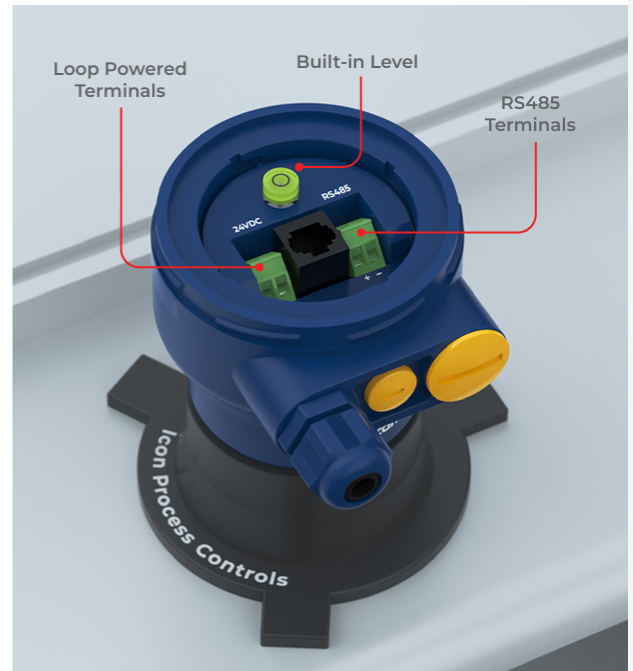
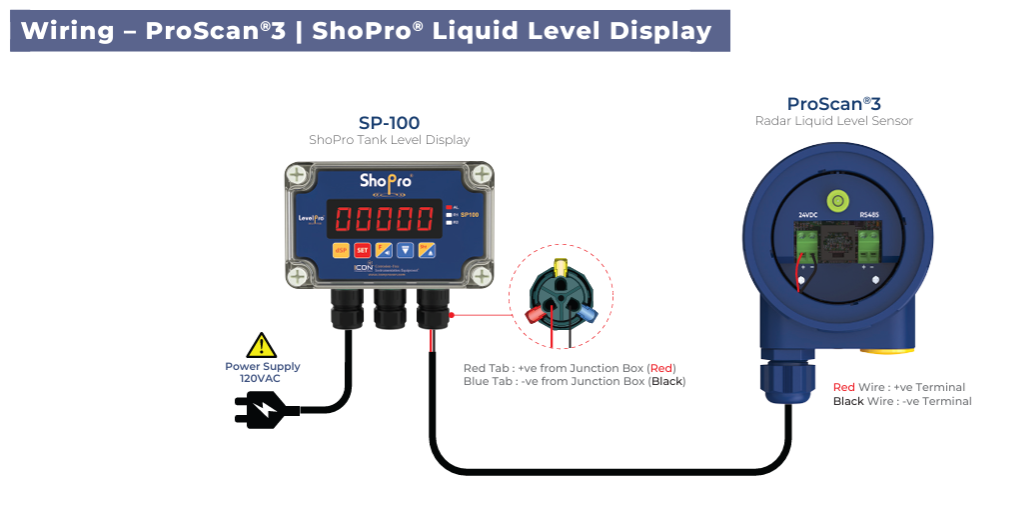
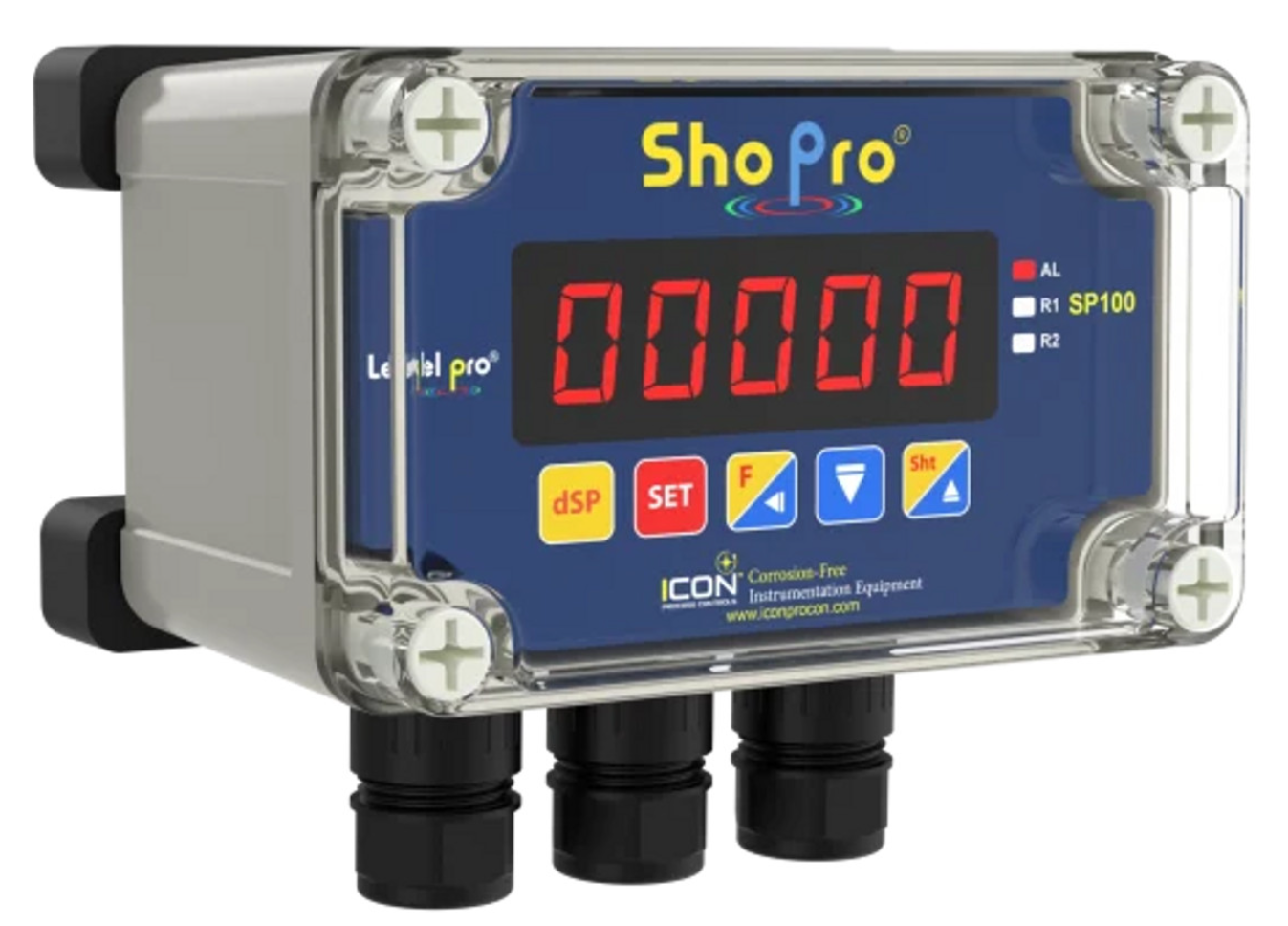
Add an external level display or level controller to complete your setup.
ShopPro Level Display and Controller
ProScan 3 80GHz Radar Liquid Level Sensor: Features, Benefits, and Applications
In industrial liquid measurement, precision is essential. Radar liquid level sensors have emerged as a reliable solution across various industries. The ProScan 3 80GHz radar liquid level sensor from Icon Process Controls offers cutting-edge technology for accurate, non-contact liquid level measurement. This blog post delves into the features, benefits, materials of construction, working principle, and ideal applications for the ProScan 3. Additionally, we compare different types of liquid level sensors and highlight where the ProScan 3 truly excels.
The ProScan®3 80 GHz high-frequency technology permits a significantly more precise transmission signal focus. Consequently, this makes it easier to distinguish between actual level signals and interference signals. Thus, making the measurement more reliable coupled with a higher degree of accuracy. Additionally, the new ProScan®3 series of compact instruments are ideally suited for more complex level applications. Furthermore, the 80 GHz radar signal is capable of penetrating through the top lid of a tank, eliminating the need for a bulkhead fitting, or having the sensor subject to the conditions inside the tank.
FAQ
WHAT IS A RADAR LEVEL SENSOR?
A liquid level sensor operates by detecting the presence or absence of material or determining the level of material within a container. This is achieved using various technologies like capacitance, ultrasonic waves, or, as in the case of radar, by measuring the time taken for a signal to bounce back from the material surface. Level sensing can be contact or non-contact-based, depending on the method employed. A radar level sensor is a device used to measure the level of liquids, solids, or slurries in various challenging industrial applications. Subsequently, it utilizes radar technology to determine the distance from the sensor to the surface of the material being measured.
HOW DOES A RADAR LEVEL SENSOR WORK?
A radar level sensor emits microwave signals that travel towards the material surface. Next, when these signals encounter the material, they are reflected back to the sensor. Hence, by calculating the time taken for the signal to return (know as time of flight), the sensor determines the distance or level of the material.
WHAT ARE THE ADVANTAGES OF RADAR LEVEL SENSORS?
- Unparalleled accuracy — often achieving millimeter-level precision, ensuring reliable measurements
- Non-contact — eliminates the need for direct interaction with the material
- Robust design — suitable for challenging environments, including extreme temperatures and pressures
- Versatile — capable of measuring various materials like liquids, solids, and slurries
Their ability to perform consistently in adverse conditions, combined with high accuracy and adaptability, positions radar level sensors as a preferred choice for many industries seeking reliable level measurement solutions.
WHAT ARE THE DIFFERENT TYPES OF RADAR LEVEL SENSORS?
There are various types of radar level sensors based on their frequency range and application needs. Common types include guided wave radar sensors (contact), and non-contact radar sensors. Each type is designed to cater to specific industrial requirements and environmental conditions.
Features of the ProScan 3 80GHz Radar Liquid Level Sensor
The ProScan 3 stands out due to its advanced technology and adaptable features. Key highlights include:
- 80GHz Frequency Technology: Enhanced signal focusing allows for precise measurements even in challenging conditions, such as dust, foam, or steam.
- Non-Contact Measurement: Provides accurate readings without making physical contact with the liquid, ensuring longer lifespan and minimal maintenance.
- Compact Design: The sensor’s small footprint makes it ideal for installations in tight spaces or complex tank configurations.
- Wide Measurement Range: Measures levels up to 30 meters (100 feet), making it versatile for small and large tanks alike.
- Easy Integration: Compatible with most industry-standard communication protocols like 4-20mA, Modbus, and HART, ensuring seamless system integration.
Benefits of the ProScan 3 Radar Liquid Level Sensor
The ProScan 3 offers several benefits that make it the preferred choice for industrial liquid level measurement:
- High Accuracy: Delivers precise measurements even with turbulent surfaces, viscous liquids, or aggressive chemicals.
- Resistant to Environmental Factors: Unaffected by changes in pressure, temperature, or humidity, ensuring consistent performance in diverse conditions.
- Maintenance-Free Operation: The non-contact nature of radar technology minimizes wear and tear, resulting in reduced maintenance costs.
- Flexibility: Suitable for a wide range of liquids, including water, oils, chemicals, and more viscous substances.
- Enhanced Safety: Ideal for hazardous or corrosive environments where contact sensors may degrade quickly.
Materials of Construction
The ProScan 3 is built using high-quality materials suited for demanding industrial environments:
- PTFE (Polytetrafluoroethylene): Used for the antenna to provide chemical resistance against aggressive liquids.
- 316 Stainless Steel: The housing offers durability and resistance to harsh conditions, including corrosive atmospheres.
- PVDF (Polyvinylidene Fluoride): Available for applications requiring strong resistance to chemicals and UV exposure.
These materials ensure that the sensor operates effectively in both standard and corrosive environments.
Working Principle of the ProScan 3 Radar Liquid Level Sensor
The ProScan 3 operates based on the time-of-flight principle. It emits a high-frequency radar signal (80GHz) that travels through the air, reflects off the liquid surface, and returns to the sensor. The time it takes for the signal to return is directly proportional to the distance from the sensor to the liquid surface. Advanced algorithms process this data, delivering accurate level measurements even in challenging conditions like dust, foam, or fluctuating temperatures.
Comparing Different Types of Liquid Level Sensors
When selecting the right liquid level sensor, understanding the differences between available technologies is essential. Below is a comparison of various types of liquid level sensors:
- Hydrostatic/Submersible Sensors: Measure pressure at the bottom of the tank to determine liquid level. Best for non-aggressive liquids but affected by density changes.
- Ultrasonic Sensors: Use sound waves to measure liquid levels. Cost-effective but prone to inaccuracies in high-temperature or high-humidity environments.
- Float Sensors: Simple mechanical design with floating elements. Best for straightforward applications but unsuitable for aggressive or turbulent liquids.
- Radar Sensors: Utilize electromagnetic waves for non-contact level measurement. Ideal for harsh, corrosive, or challenging environments with dust, foam, or steam.
Why the ProScan 3 Is the Best Choice for Certain Applications
The ProScan 3 radar liquid level sensor is the best choice for applications requiring high accuracy, reliability, and minimal maintenance in harsh environments. Ideal applications include:
- Chemical Processing: Handles aggressive chemicals like acids and solvents without degradation.
- Wastewater Treatment: Accurately measures levels in tanks with foam, sludge, or turbulent surfaces.
- Food and Beverage: Suitable for hygienic applications where non-contact measurement is required to avoid contamination.
- Pharmaceuticals: Provides precise level control in cleanroom environments or sterile production processes.
- Oil and Gas: Monitors liquid levels in storage tanks with volatile or hazardous substances.