
Distilled vs. Deionized Water: Which Type of Purified Water Is Right for You?
Posted by David Cannon on 30th Jul 2026
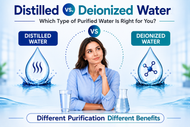
Water is the foundation of human life and one of the most important nutrients the body needs to function properly. On average, the human body is made up of approximately 50% to 70% water, with the exact percentage varying based on age, sex, and body composition. Every organ, tissue, and cell depends on water to perform essential biological processes that support overall health and well-being.
Unlike many nutrients that the body can store for extended periods, water must be replenished regularly through beverages and water-rich foods. Even mild dehydration can affect physical performance, concentration, and normal physiological functions, making adequate hydration an important part of a healthy lifestyle.
What Is Purified Water?
Purified water is water that has undergone one or more treatment processes to remove physical, chemical, and biological impurities. These impurities may include suspended particles, dissolved minerals, microorganisms, organic compounds, heavy metals, and other contaminants that can affect water quality, safety, or suitability for specific applications.
The primary goal of water purification is to produce water that meets defined quality standards for its intended use. Depending on the purification method and the desired level of purity, purified water can be used for drinking, laboratory research, pharmaceutical manufacturing, food and beverage processing, electronics production, and various industrial processes where consistent water quality is essential.
Unlike untreated water, purified water is processed using specialized technologies designed to target specific contaminants. Common water purification methods include:
- Filtration
- Reverse Osmosis
- Distillation
- Deionization
- Ultraviolet (UV) Disinfection
- Activated Carbon Filtration
What Is Distilled Water?
Distilled water is a type of purified water produced through distillation, a process that involves boiling water to create steam and then cooling the steam back into liquid form. During this process, many dissolved minerals, salts, heavy metals, and a wide range of contaminants are left behind, resulting in water with a very low mineral content.
From a human consumption perspective, distilled water is considered safe to drink when it is produced, handled, and stored under sanitary conditions. Because the distillation process removes most dissolved minerals such as calcium, magnesium, sodium, and potassium, distilled water differs from many natural drinking water sources that contain these naturally occurring minerals.
What Is Deionized Water?
Deionized (DI) water is a type of purified water that has undergone an ion-exchange process to remove dissolved mineral ions. Unlike distillation, which purifies water through evaporation and condensation, deionization uses specialized ion-exchange resins to remove positively charged ions (cations) such as calcium, magnesium, sodium, and iron, along with negatively charged ions (anions) such as chloride, sulfate, nitrate, and bicarbonate.
The result is water with very low electrical conductivity and a minimal concentration of dissolved minerals, making it ideal for applications that require high-purity water.
Water Quality Parameters You Should Consider for Human Body
Approximately 60% of the adult human body is composed of water. Drinking contaminated or poorly treated water may expose individuals to harmful microorganisms, heavy metals, excessive minerals, or chemical contaminants that can affect short-term and long-term health.
- Calcium
- Magnesium
- Sodium
- Potassium
- Chloride
- Sulfate
How Does Deionized Water Affect the Human Body?
From a human health perspective, it is important to distinguish water purity from water intended for consumption. Although deionized water is highly purified in terms of dissolved ions, it is primarily produced for industrial, laboratory, pharmaceutical, and manufacturing applications rather than everyday drinking.
Is Deionized Water Safe to Drink?
Deionized water itself is not inherently toxic, but it is generally not recommended as a regular source of drinking water for several practical reasons:
- It contains almost no naturally occurring minerals because the deionization process removes dissolved ions.
- It is primarily produced for technical and industrial applications rather than consumer hydration.
- Due to its high purity, deionized water can readily absorb minerals, gases, and other substances from storage containers or the surrounding environment, which may affect its quality if not properly handled.
For these reasons, deionized water should not be assumed to be suitable for everyday consumption.
Distilled Water vs. DI (Deionized) Water for Drinking
Although both distilled water and deionized (DI) water are classified as purified water, they are produced using different purification methods and are intended for different applications. Understanding these differences is important when determining whether either type of water is appropriate for human consumption.
Both purification processes remove many impurities, but they target different contaminants.
- Distilled water is produced by boiling water into steam and condensing it back into liquid. This process removes most dissolved minerals, microorganisms, and many non-volatile contaminants.
- Deionized water is produced by passing water through ion-exchange resins that remove dissolved mineral ions such as calcium, magnesium, sodium, and chloride. However, deionization alone does not necessarily remove all microorganisms, organic compounds, or certain non-ionic contaminants.
Is Distilled Water Safe to Drink?
Yes. Distilled water is generally considered safe for human consumption when it is produced, packaged, and stored under sanitary conditions.
Key points:
- It contains very low levels of dissolved minerals.
- It provides hydration just like other safe drinking water sources.
- It is commonly used where high-purity water is preferred, such as in certain medical devices, laboratories, and food processing.
- The body obtains most essential minerals from a balanced diet rather than from drinking water.
Key Differences Between Distilled Water & Deionized Water
Distilled water and deionized (DI) water are both highly purified forms of water, but they are produced using different purification methods and are intended for different applications. While both remove many contaminants found in tap water, they differ significantly in mineral content, purity, production process, and suitability for drinking or industrial use.
Understanding these differences helps consumers, laboratories, healthcare professionals, and industrial users choose the right type of purified water for their specific needs.
|
Feature |
Distilled Water |
Deionized (DI) Water |
|
Purification Method |
Produced through boiling and condensation (distillation) |
Produced by ion exchange resins that remove charged ions |
|
Removes Dissolved Minerals |
Yes |
Yes |
|
Removes Bacteria & Viruses |
Yes (during proper distillation) |
Not necessarily |
|
Removes Organic Compounds |
Most contaminants are removed, depending on boiling point |
Limited removal unless combined with additional filtration |
|
Mineral Content |
Extremely low |
Nearly zero |
|
Taste |
Flat due to lack of minerals |
Flat and sometimes slightly different due to ultra-low ion content |
|
Suitable for Drinking |
Yes, occasionally |
Generally, not recommended as regular drinking water |
|
Common Applications |
Drinking, medical equipment, CPAP machines, laboratories |
Laboratories, pharmaceutical manufacturing, electronics, industrial processes |
Key Takeaways:
Both distilled water and deionized (DI) water are purified by removing impurities, but they are produced in different ways and are not always suitable for the same applications.
- Distilled water is made by boiling water into steam and then cooling the steam back into liquid water. This process removes most impurities and contaminants.
- Deionized (DI) water is made by passing water through special ion exchange resins that remove dissolved minerals and electrically charged particles (ions).
In addition to not supplying minerals, deionized water is corrosive and can cause damage to tooth enamel and soft tissues. Also, deionization does not remove pathogens, so DI water may not protect against infectious diseases.
Choosing the right type of purified water depends on your specific application rather than which one is "better." Understanding how each purification method works and where it performs best helps you make an informed decision, improve equipment reliability, maintain product quality, and meet industry requirements.