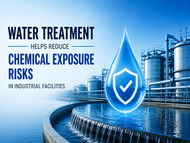
How Water Treatment Helps Reduce Chemical Exposure Risks in Industrial Facilities?
Posted by David Cannon on 13th Jul 2026
Industrial facilities depend on a wide range of chemicals to support manufacturing processes, maintain equipment performance, and ensure product quality. These include acids, alkalis, disinfectants, solvents, corrosion inhibitors, biocides, and specialty treatment chemicals. While these chemicals are essential for efficient operations, improper handling or excessive use can increase the risk of worker exposure, equipment damage, environmental compliance challenges, and higher operating costs.
Hence, chemical exposure in the workplace remains a significant concern across manufacturing plants, waste water treatment plants, power generation facilities, food processing operations, chemical processing sites, and other industrial environments.
One effective way to minimize these risks is through optimized industrial water treatment. By improving water quality and process efficiency, optimized industrial water treatment systems can help reduce reliance on treatment chemicals while improving process efficiency.
This blog explores how water treatment supports chemical exposure management and helps facilities build safer, more efficient operations.
Why Chemical Exposure at Work Remains a Major Challenge in Process Industries
Chemical exposure in process industries often occurs during routine operating, maintenance, and chemical handling activities. From chemical dosing and storage to equipment cleaning and wastewater treatment, workers regularly interact with potentially hazardous substances as part of their daily responsibilities. Some of the most common sources of chemical exposure include:
- Chemical Mixing and Dosing: Operators routinely handle concentrated chemicals during mixing, dilution, and dosing operations, increasing the risk of splashes, spills, and direct skin contact.
- Chemical Storage and Transfer: Inspecting storage tanks and transferring chemicals between storage vessels and process equipment can expose workers to leaks, vapors, and accidental releases.
- Equipment Maintenance and Cleaning: Maintenance personnel frequently work with cleaning agents, descalers, corrosion removers, and other specialty chemicals while servicing process equipment and piping systems.
- Wastewater Treatment Operations: Wastewater treatment systems often rely on acids, alkalis, coagulants, flocculants, disinfectants, and other treatment chemicals, requiring regular handling and monitoring that can increase the potential for chemical exposure.
The chemical exposure effects associated with these incidents vary widely. Short-term exposure may cause irritation, burns, respiratory discomfort, or eye injuries. Long-term chemical exposure can involve more serious concerns such as respiratory, cardiac, and reproductive health issues depending on the substances involved and the duration of exposure. Hence, many facilities are exploring practical ways to prevent chemical exposure by reducing unnecessary handling throughout their operations.
Key Steps to Minimize Chemical Exposure Risks
Optimizing industrial water treatment is one of the most effective ways to reduce chemical exposure risks. Here are some of the key ways it helps improve workplace safety and process efficiency:
- Optimize Water Quality to Reduce Chemical Consumption: Poor water quality creates a chain reaction of operational problems. Untreated or poorly treated water often increases dependence on corrosion inhibitors, descaling agents, disinfectants, biocides, and cleaning chemicals. Facilities may find themselves adding more chemicals simply to compensate for underlying water quality issues. Technologies such as reverse osmosis, deionization, filtration, and water softening remove contaminants before they create downstream challenges. This has many benefits.
- Reduced dependence on treatment chemicals through cleaner, more consistent feedwater quality.
- Lower chemical storage and inventory requirements, simplifying chemical handling and inventory management.
- Fewer opportunities for worker exposure due to reduced chemical handling and dosing activities.
- Improved equipment performance and process reliability through stable water quality and optimized system operation.
- Automate Chemical Dosing Wherever Possible: Employees in industrial facilities measure treatment chemicals, transport containers, pour liquids, and verify concentrations. Each step creates opportunities for spills, splashes, or accidental contact. Automation reduces these challenges significantly by delivering precise chemical quantities based on process requirements. This offers the following benefits.
- Reduced manual handling of concentrated chemicals, allowing operators to focus more on system monitoring and process control.
- More accurate chemical dosing, helping maintain stable water chemistry while reducing the risk of over or under dosing.
- Greater process consistency, supporting reliable water treatment performance across multiple shifts and varying operating conditions.
- Control Scale, Fouling, and Corrosion Before They Require Aggressive Cleaning: Scale, fouling, and corrosion remain common challenges in industrial water systems. Heat exchangers lose efficiency when deposits accumulate. Cooling towers experience scale buildup. Boiler systems become vulnerable to corrosion damage. If left untreated, these issues eventually require corrective maintenance involving hazardous chemicals such as alkaline cleaners, descaling compounds, thus increasing chemical exposure risk. Preventive water treatment solves the issue. Proper filtration, water softening, chemical optimization, and process monitoring help control deposits before they become severe. There are many benefits that follow:
- Cleaner, more efficient equipment, supporting reliable system performance and longer service life.
- Reduced need for aggressive cleaning procedures, helping minimize worker exposure to hazardous cleaning chemicals.
- Use Continuous Water Monitoring Instead of Reactive Chemical Adjustments: Many facilities still rely on periodic testing and manual process adjustments. However, when water chemistry drifts outside acceptable limits, operators may need emergency chemical corrections to restore system conditions. These reactive responses often involve larger chemical additions and increased handling activity. Continuous monitoring through real-time monitoring systems enables tracking of critical parameters such as conductivity, pH, dissolved solids, flow rates, and treatment performance. Here are its benefits.
- Earlier detection of process deviations, allowing operators to address small changes before they develop into larger operational problems.
- More precise chemical dosing through continuous monitoring of water quality and treatment performance, ensuring chemicals are added only when required.
- More stable operating conditions, reducing unnecessary process adjustments and improving overall treatment efficiency.
- Fewer emergency chemical interventions, helping minimize chemical handling activities and reduce opportunities for worker exposure.
- Use Integrated Water Treatment Systems to Minimize Chemical Handling: Many facilities manage filtration, dosing, monitoring, and chemical treatment as separate processes. Integrating these functions into a coordinated water treatment system improves process control, reduces manual intervention, and minimizes unnecessary chemical handling. Benefits include:
- Reduced manual interaction with treatment chemicals, helping minimize operator exposure during routine operations.
- Better coordination between water quality monitoring and chemical dosing, improving treatment accuracy and process control.
- Greater operational efficiency, supporting smoother system performance with fewer process interruptions.
Optimize Your Water Treatment with Cannon Water Technology
Reducing chemical exposure requires more than PPE and safety protocols; it starts with optimizing the water treatment process itself. By improving water quality, implementing filtration systems, automating chemical dosing, and enabling continuous monitoring, facilities can reduce chemical consumption, minimize manual chemical handling, and support safer, more efficient operations.
Cannon Water Technology offers a comprehensive range of water treatment solutions, including filtration systems, flow control systems, reverse osmosis components, monitoring equipment, flow meters, and water testing instruments. Contact our team today to find the right solutions for your industrial water treatment requirements.