
Cooling Tower Blowdown Explained: Why It’s Essential for Water Quality Control?
Posted by David Cannon on 10th Apr 2026
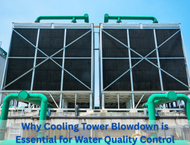
Before diving into cooling tower blowdown, it helps to picture what a cooling tower actually does. Industrial facilities, power plants, refineries, data centers, HVAC systems in large buildings generate enormous amounts of heat from their processes.
A cooling tower's job is to dump that heat into the atmosphere using water as the vehicle. Hot water from the process flows into the tower, gets sprayed over packing material, and a portion of it evaporates. That evaporation carries the heat away, cooling the remaining water, which then circulates back to cool the process again.
The Concentration Problem in Cooling Tower. Why Blowdown is Necessary?
Here is the core problem: when water evaporates from the tower, it leaves everything else behind. Pure H₂O floats off as vapor. But the dissolved minerals like calcium, magnesium, silica, chlorides, sulfates stay in the basin water. Every cycle of evaporation concentrates these minerals a little more.
Think of it like a pot of soup left simmering on the stove. As the water boils off, the soup gets saltier and thicker. The same thing happens in a cooling tower basin, but with minerals that form scale, promote corrosion, and create biological hazards.
This concentration effect is measured by a number called the Cycles of Concentration (CoC), sometimes also called the Concentration Ratio (CR). It is simply the ratio of dissolved solids in the circulating water compared to the fresh makeup water.
Blowdown is the controlled release of a portion of this concentrated circulating water - replaced by fresh makeup water to keep the CoC within acceptable limits and maintain water quality.
Why Cooling Tower Blowdown Treatment is Critical for Water Quality Control?
Cooling towers play a key role in many industrial processes by removing heat from water systems. However, as water continuously circulates and evaporates, it leaves behind dissolved solids, minerals, and impurities. Over time, these contaminants build up and can negatively impact water quality.
This is where cooling tower blowdown becomes essential. Blowdown is the process of removing a portion of concentrated water from the system and replacing it with fresh water. This helps maintain the right balance of dissolved solids and prevents serious issues like scaling, corrosion, and biological growth.
Without proper blowdown control, cooling systems can face reduced efficiency, higher energy consumption, equipment damage, and increased maintenance costs. On the other hand, optimized blowdown practices improve system performance, extend equipment life, and ensure compliance with water quality standards.
Key Cooling Tower Blowdown Water Parameters to Monitor
Monitoring the right parameters in cooling tower blowdown is essential to maintain water quality, prevent system damage, and optimize operational efficiency. Here are the key parameters you should track, explained in simple terms:
- Total Dissolved Solids (TDS) - TDS meter measures the total amount of dissolved minerals, salts, and impurities in the water.
- Conductivity - Conductivity indicates how well water can conduct electricity, which directly relates to the concentration of dissolved ions.
- pH Level - pH shows whether water is acidic or alkaline.
- Hardness (Calcium & Magnesium) - Hardness refers to calcium and magnesium levels in the water.
- Alkalinity - Alkalinity measures the water’s ability to neutralize acids.
- Chlorides - Chloride levels are important indicators of corrosion risk.
- Silica - Silica is a common scaling compound that is difficult to remove.
- Microbial Activity (Bacteria & Biofilm) - Cooling towers are prone to biological growth so it requires regular biocide treatment and monitoring.
- Water Temperature - Water temperature impacts chemical reactions and microbial growth.
What Happens If You Don't Blowdown?
Without blowdown, three serious problems develop quickly:
- Scale formation - calcium carbonate, calcium sulfate, and silica deposits build up on heat exchanger surfaces, fill media, and pipes. Even a 1 mm layer of scale can reduce heat transfer efficiency by 10–15%, forcing the process equipment to work harder and consume more energy.
- Corrosion - high chloride and sulfate concentrations attack steel components, causing pitting and premature equipment failure.
- Biological growth - warm, nutrient-rich concentrated water is an ideal breeding ground for bacteria, algae, and, most critically, Legionella pneumophila - the bacteria responsible for Legionnaires' disease.
Why Chemical Treatment Matters in Cooling Tower Blowdown?
Cooling tower blowdown water is not ordinary wastewater. By the time water is discharged as blowdown, it has been cycled through the system multiple times - picking up concentrated minerals, corrosion byproducts, biological matter, and the residue of treatment chemicals added along the way. Simply sending this water down a drain untreated is both environmentally harmful and, in most jurisdictions, illegal.
Chemical treatment of cooling tower blowdown serves two distinct purposes. The first is keeping the circulating water itself in a condition that protects equipment and maintains efficient heat transfer. The second is conditioning the blowdown stream before it is discharged or reused, so it meets regulatory and quality standards. Both goals are achieved through a coordinated chemical treatment program.
- Scale Inhibitors: Scale is the most common and costly problem in cooling tower systems. As water concentrates through repeated cycles of evaporation, minerals like calcium carbonate, calcium sulfate, calcium phosphate, magnesium silicate, and silica approach or exceed their solubility limits and begin to precipitate onto heat exchanger surfaces, fill media, pipes, and basin walls. Scale inhibitors are typically dosed continuously into the circulating water via metering pumps, calibrated to maintain a residual target concentration in the circulating water.
- Corrosion Inhibitors: Corrosion in cooling tower systems attacks steel, copper, galvanized components, and concrete basin surfaces. The drivers are numerous: dissolved oxygen, low pH, high chloride and sulfate concentrations, galvanic coupling between dissimilar metals, and aggressive blowdown chemistry if not properly managed.
- Biocides and Biological Control: Warm, nutrient-rich cooling tower water is essentially an ideal incubator for microorganisms. Algae colonize sun-exposed surfaces and clog fill media. Bacteria form biofilms - sticky mats that reduce heat transfer efficiency, accelerate corrosion beneath them. Effective biological control in cooling systems is not optional - it is a life-safety requirement in most regulatory frameworks.
- pH and Alkalinity Control: pH is the master variable of cooling water chemistry. It influences the effectiveness of nearly every other chemical treatment, the solubility of scale-forming minerals, the aggressiveness of corrosion, and the efficacy of biocides.
Common Chemical Treatment Mistakes and How to Avoid Them?
Even well-intentioned chemical treatment programs fail for cooling tower blowdown process when these common errors occur:
- Underdosing to cut costs - Scale inhibitors and corrosion inhibitors have minimum effective threshold concentrations. Cutting dose below this threshold provides little or no protection while still incurring chemical costs. The cost of equipment damage from inadequate treatment far exceeds the chemical savings.
- Running a single biocide indefinitely - Microbial populations adapt. Rotation between non-oxidizing biocides is essential to prevent resistant strains from establishing themselves, particularly in biofilm communities.
- Neglecting pH control - Many operators focus on adding chemicals but neglect the foundational pH control that governs everything else. A system running at pH 9.0 with a good scale inhibitor will still scale aggressively with calcium carbonate because the inhibitor cannot overcome extreme supersaturation.
- Ignoring blowdown water quality for discharge - Focusing only on circulating water quality while sending untreated blowdown to drain is an environmental compliance risk and increasingly a regulatory enforcement target.
- Failing to clean before treating - Chemical inhibitors protect clean metal surfaces. They do not remove existing deposits. A system with years of scale buildup must be descaled - chemically with inhibited acid before a new inhibitor program can function as designed.
- Not testing - Relying on dosage rates alone, chemical feed rates are starting points, not guarantees. Regular water analysis (at minimum weekly for operating systems) is essential to confirm that target residuals are being achieved and that water quality parameters are within specification.
Cooling tower blowdown chemical treatment is not a single chemical or a single step. It is a coordinated, multi-component program designed to simultaneously protect equipment, maintain water quality, control biological hazards, and ensure regulatory compliance for the discharged effluent.