
How Ion Exchange Improves Water Quality in Manufacturing Plants?
Posted by David Cannon on 14th May 2026
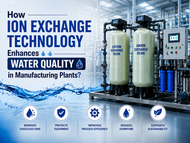
Water is one of those inputs that quietly decides how well a manufacturing or processing plant runs. It flows through boilers, circulates in cooling towers, cleans components on production lines, and becomes an ingredient in finished products. While it does its job quietly in the background, maintaining consistent water quality is essential for reliable and efficient plant performance. Poor water quality slows down operations or even damages equipment. It causes scale accumulation inside heat exchangers, chokes heat transfer, and leads to corrosion, fouling, leakage issues, thus increasing energy, downtime, and maintenance costs.
Basic filtration systems don’t work here. Hence, industries are increasingly moving beyond basic filtration and adopting advanced water treatment systems, such as ion exchange water treatment system. This post discusses the significance of ion exchange filters in improving water quality across manufacturing plants.
What is Ion Exchange in Industrial Water Treatment?
At its core, ion exchange water treatment is a chemical exchange. Water passes through a bed of resin beads, and undesirable ions in the water are exchanged for more acceptable ones held on the surface of those beads. This is the basic principle behind an ion exchange resin water filter or a full-scale ion exchange filter system used in industrial plants. Here's what happens at the molecular level.
- Resin beads carry charged functional groups.
- When water flows past, dissolved ions in solution are attracted to those groups and attach to the bead surface. In exchange, the resin releases a different ion into the water. For instance, calcium and magnesium ions that cause hardness are captured.
- In return, sodium or hydrogen ions are released into the water. The same idea applies to anions like chloride or sulfate when anion resins are used.
- The resin acts as the active medium. It keeps working until it becomes saturated. At that point, it is regenerated using a controlled chemical solution and reused again. That repeatability is one reason industries prefer ion exchange systems over one-time-use filtration methods.
How Ion Exchange Improves Water Quality in Manufacturing Plants
Ion exchange filtration improves industrial water quality by selectively removing dissolved ions that negatively affect equipment performance, process stability, and product quality. Here is how ion exchange water treatment helps:
- Removal of Hardness-Causing Minerals: Calcium and magnesium are the primary contributors to water hardness. These ions readily precipitate on heat transfer surfaces, forming scale that acts as a thermal barrier. This reduces heat transfer efficiency, increases energy consumption, and leads to premature equipment wear. An ion exchange water softener eliminates this issue by exchanging calcium and magnesium ions with sodium ions as water passes through the resin bed. The treated water is chemically softened and significantly less likely to form scale in boilers, heat exchangers, and distribution systems.
- Reduction of Dissolved Solids (TDS Control): High TDS can disrupt sensitive manufacturing processes, cause boiler foaming, and degrade product quality. Many industries require low-TDS or demineralized water beyond typical municipal supply levels. Ion exchange water treatment systems, particularly dual-bed or mixed-bed configurations, are highly effective in reducing dissolved ionic content. These systems are widely used to produce demineralized and ultrapure water for pharmaceuticals, semiconductor manufacturing, and power generation.
- Prevention of Corrosion in Equipment: Chloride and sulfate ions accelerate corrosion mechanisms such as pitting and stress corrosion cracking in metallic systems. This damage often progresses unnoticed until operational failure occurs. Anion exchange resins remove these corrosive ions before they reach critical equipment, reducing degradation in boilers, pipelines, and heat exchangers.
- Enhancement of Process Efficiency and Product Consistency: Stable water chemistry ensures consistent process conditions. An ion exchange filter system maintains defined ionic parameters, reducing variability in production outcomes and supporting tighter process control.
- Regulatory Compliance and Quality Standards: Industries must meet strict water quality requirements defined by standards such as FDA, USP, and EPA. Ion exchange systems provide consistent performance and monitoring capability, supporting compliance documentation and audit readiness in regulated manufacturing environments.
Common industrial applications include boiler feed water softening, cooling tower makeup water treatment, ultrapure water production for electronics manufacturing, process water for pharmaceutical and food-grade production, and wastewater polishing before discharge.
Types of Ion Exchange Resins Used Across Industries
Here are the types of resins used.
- Cation Exchange Resins: These resins attract positively charged ions such as calcium (Ca²⁺), magnesium (Mg²⁺), and iron (Fe²⁺), which are responsible for hardness and scaling. In practical applications, they are used in different forms depending on the treatment objective. In water softening applications, sodium-form resins are commonly used, while hydrogen-form resins are used in demineralization to convert dissolved salts into acids.
- Anion Exchange Resins: These remove negatively charged ions such as chloride (Cl⁻), sulfate (SO₄²⁻), and nitrate (NO₃⁻). When used with cation resins in deionization systems, they help produce high-purity water for sensitive industrial processes.
- Mixed Bed Resins: These combine cation and anion resins in a single vessel to achieve very high purity levels. They are typically used as a final polishing stage in ultrapure water systems.
- Specialty Resins: These target specific contaminants such as heavy metals (lead, copper, nickel) or dissolved organics. The selection of resins depends on the exact composition of the feed water and process requirements.
Key Benefits of Ion Exchange for Manufacturing Plants
Here are some of the benefits of this filtration technology.
- High Purity Water Output: Ion exchange reliably produces water with very low dissolved ion content. It is widely used in semiconductor rinsing, pharmaceutical formulation, and high-pressure boiler feedwater systems where even trace impurities can affect performance.
- Cost Efficiency Over Time: While initial system investment exists, ion exchange reduces long-term expenses linked to scaling, corrosion, and equipment failure. Resin regeneration allows reuse of media, keeping operating costs manageable compared to frequent part replacement or chemical cleaning.
- Operational Reliability: These systems deliver stable water quality when properly designed and maintained. The resin bed has no mechanical components, and performance can be monitored through straightforward parameters such as conductivity or hardness, supporting predictable operation in continuous processes.
- Equipment Longevity: By controlling water chemistry, ion exchange minimizes scaling and corrosion, extending the service life of boilers, cooling systems, and process equipment.
- Flexible System Design: Ion exchange systems are highly scalable and can be configured for a wide range of applications, from small units such as ion exchange systems for well water to large, plant-wide industrial water treatment systems.
Design Considerations for Industrial Ion Exchange Systems
Designing an ion exchange system requires careful alignment with actual operating conditions. Poor design decisions often lead to performance issues that are difficult to correct later. Here are some factors to consider when designing these systems.
- Feed Water Analysis: A detailed water test is the starting point. Parameters such as hardness, TDS, pH, iron, silica, organic content, and turbidity directly influence resin selection, vessel sizing, and regeneration cycles. Without this data, systems are often mis-sized or inefficient from the beginning.
- System Capacity and Flow Rate Design: The system must handle both average and peak demand. If it is sized only for average flow, bottlenecks occur during high usage periods. Many industrial setups use parallel trains or added capacity to maintain continuous supply.
- Resin Selection Strategy: Resin choice depends on the contaminant profile. Strong acid cation resins are used for hardness removal, while strong base anion resins address anionic contaminants. Pre-treatment or specialty resins may be required when iron or organics are present.
- Regeneration Process Design: Proper regeneration restores resin capacity using salt, acid, or caustic solutions. Chemical strength, contact time, and flow rate must be optimized to ensure full recovery and consistent performance.
- System Configuration Options: Single-bed systems suit basic softening, dual-bed systems support full deionization, and mixed-bed units are used for final polishing where ultra-pure water is required.
- Automation and Monitoring Systems: Modern systems use sensors and PLC controls to track conductivity and trigger regeneration based on actual resin exhaustion rather than fixed schedules.
- Waste Disposal and Environmental Compliance: Regeneration effluent contains concentrated salts and chemical residues that must be managed in accordance with environmental regulations. Appropriate neutralization, treatment, or disposal strategies must be incorporated into system design to ensure regulatory compliance.
Environmental and Sustainability Benefits of Ion Exchange
Here are some key benefits.
- Water Conservation through Resin Reuse: Ion exchange resins are regenerated and reused over many cycles instead of being discarded after single use. This reduces freshwater demand compared to single-pass treatment systems and extends the usable life of the media.
- Lower Chemical Consumption in Operations: Optimized regeneration uses only the required amount of chemicals to restore resin capacity. This reduces chemical waste, limits overdosing, and lowers overall operating costs.
- Energy Savings in Industrial Processes: Preventing scale formation on heat transfer surfaces improves thermal efficiency in boilers and heat exchangers. This reduces fuel consumption and improves overall energy performance of industrial systems.
- Reduced Industrial Waste Generation: By minimizing scaling and corrosion, equipment lasts longer, reducing the need for frequent replacement and lowering scrap and manufacturing waste.
- Integration with Sustainable Systems: Ion exchange supports Zero Liquid Discharge (ZLD) and closed-loop recycling systems by polishing recovered water for reuse, helping facilities reduce environmental discharge and improve water recovery efficiency.
Best Practices for Maximizing Ion Exchange System Performance
Getting the most out of an ion exchange water treatment system comes down to consistent, disciplined operation. Here are the practices that make significant difference.
- Routine water quality monitoring: Track treated water conductivity, pH, and hardness regularly. Early deviation from spec is far easier to address than a full system failure.
- Scheduled resin regeneration and replacement: Follow a regeneration schedule based on actual water usage and feed water quality, not just a calendar. Replacement should be initiated when regeneration no longer restores full exchange capacity.
- Pre-treatment filtration: Protect the resin bed by removing suspended solids, iron, and organics upstream. This single step does more to extend resin life,
- Operator training and system automation: Effective system performance depends on a balance between automation and operator competency. Automation ensures consistent and repeatable operation under defined parameters, while trained operators are essential for interpreting system behavior, managing exceptions, and responding to abnormal operating conditions.
For many plants, switching to an ion exchange water treatment system is less about upgrading technology and more about stabilizing operations. Once water quality becomes predictable, everything else becomes easier to manage. Cannon Water Technology brings decades of application experience in helping facilities select, size, and implement water filtration systems that genuinely deliver reliable performance.