
Ever wondered how much water volume is in your closed loop?
Posted by David Cannon on 16th Aug 2018
Often we get calls from our customers who are looking for corrosion inhibitor chemicals or glycol for their closed loop systems. The first question we ask is 'How much water does your system hold?' and the answer is always 'I don't really know'. To figure this out the plumber or mechanical contractor might try and estimate the volume by counting the length and diameter of the pipe installed but this does not take into account all of the fittings, valves, water heaters, boiler capacity etc.
Replace Your Waters Equipment W9000 Sample Cooler with the Neptune SC-316
Posted by David Cannon on 29th May 2018
Effective June 1st 2018 the Waters Equipment W9000 Sample Cooler will be discontinued. The good news is you can get a direct drop in replacement with the same specifications and connections and dimensions by using the always available Neptune SC-316 Sample Cooler. Waters W9000 Sample Cooler Neptune SC-316 Sample CoolerI can't confirm this for sure but rumor has it that the Waters W9000 was being made by Neptune so if that's t
Closed System Water Treatment For Leaky Systems
Posted by David Cannon on 28th Aug 2017
To continue to treat a closed heating or cooling system that leaks with a closed system treatment chemical can be very expensive. To not treat a leaking system can be even more expensive. A closed system that has a leak and no treatment is 100% guaranteed to corrode and develop fouled and plugged coils and heat exchangers. It is just a matter of time, before catastrophic failures will develop.
Traditional Water Treatment:
Nitrite based corrosion inhibitors are used in 90% of treated closed
Closed System Water Treatment Problems: Corrosion
Posted by David Cannon on 4th May 2017
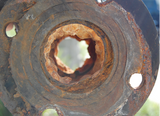
Some of the leading conditions that can cause problems in closed systems are: Leaks. Water loss, either through leaks or intentional releases, will drain away any chemical corrosion protection and introduce fresh, oxygen rich, water. When fresh water enters a closed system the dissolved oxygen will react with metals such as iron and copper. When oxygen reacts with iron it forms iron oxide (rust) that can expand the thickness of the iron by up to 20 times.Exposure to atmosp